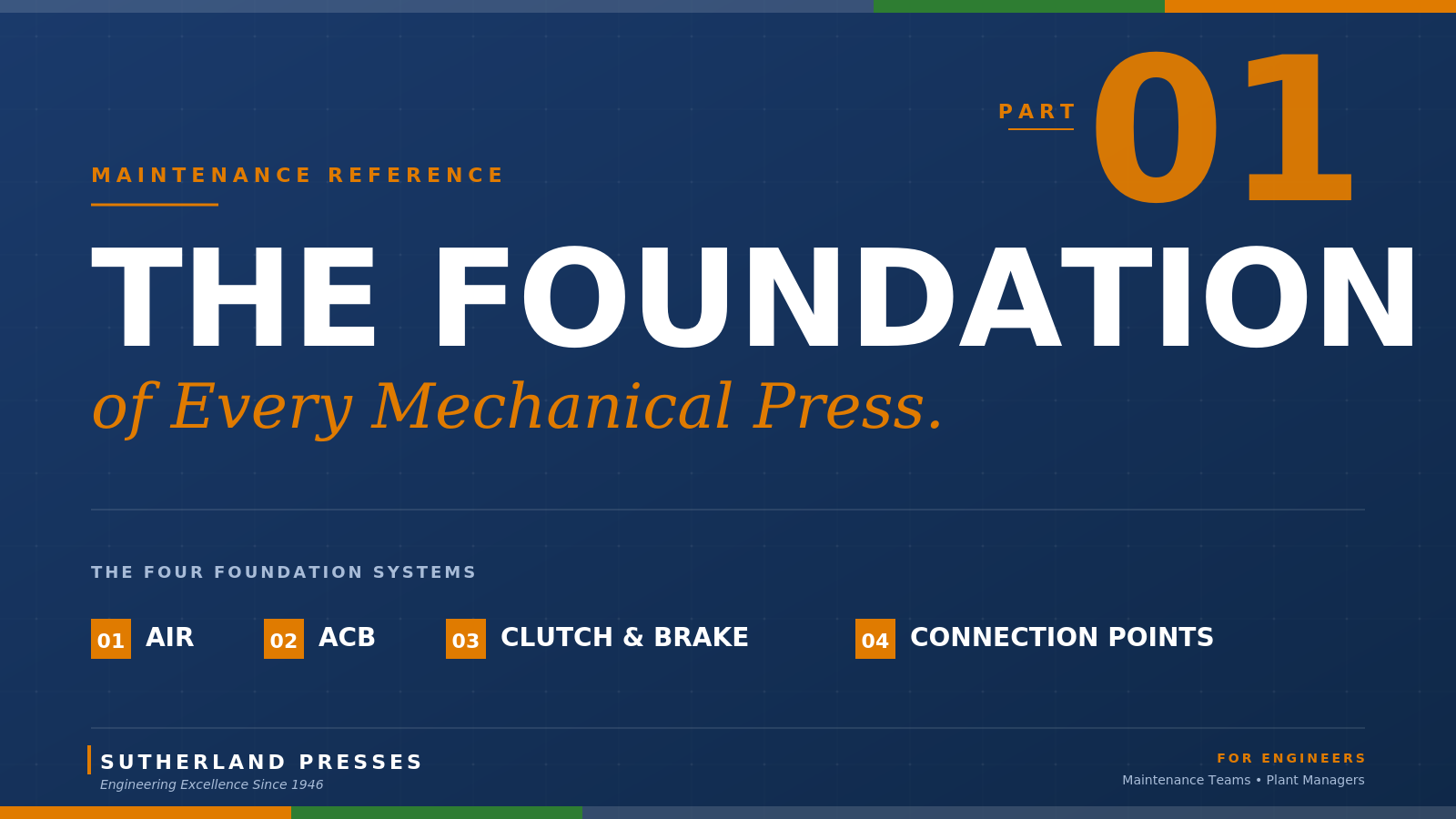
THE FOUNDATION OF EVERY MECHANICAL PRESS: AIR, ACB, CLUTCH & BRAKE, CONNECTION POINTS

Jun 7, 2026
Maintenance Tips
Sutherland Presses logo
Maintenance Reference | For Engineers and Maintenance Teams

Air, ACB, Clutch & Brake, Connection Points.
The Foundation of Every Mechanical Press.

Eighty percent of unplanned press downtime traces back to the four foundation systems below. Industry data places unplanned downtime at 23% of all lost production hours in forming and forging plants. The remediation is not a software upgrade or a control retrofit. It is a weekly maintenance cycle on systems that have not changed since the 1940s, executed with discipline. This article documents specific failure thresholds, inspection intervals, and the test methods Sutherland service technicians use on every preventative maintenance audit.

The four systems covered here are the foundation: air systems, the Air Counter-Balance (ACB), the clutch and brake unit, and the connection points that transfer drive energy from motor to slide. Every other system on the press depends on these four operating to factory specification. The full eleven-system reference is documented in the Sutherland Press Maintenance Tips.

23%
Unplanned DowntimeIndustry Average
110%
HOLP TriggerOf Press Capacity
10% max
Reverse TonnageOn Blanking Operations
System 01 of 11

Air Systems. The Pneumatic Backbone.

Air systems are crucial to mechanical presses and necessary on most servo hydraulic presses. They drive the clutch and brake, the air counter-balance, the HOLP overload protection, and (on hydraulic presses) the slide locking mechanism. Every press should be equipped with an electronically monitored air pressure switch that prevents press operation when supply pressure falls below the factory specification.
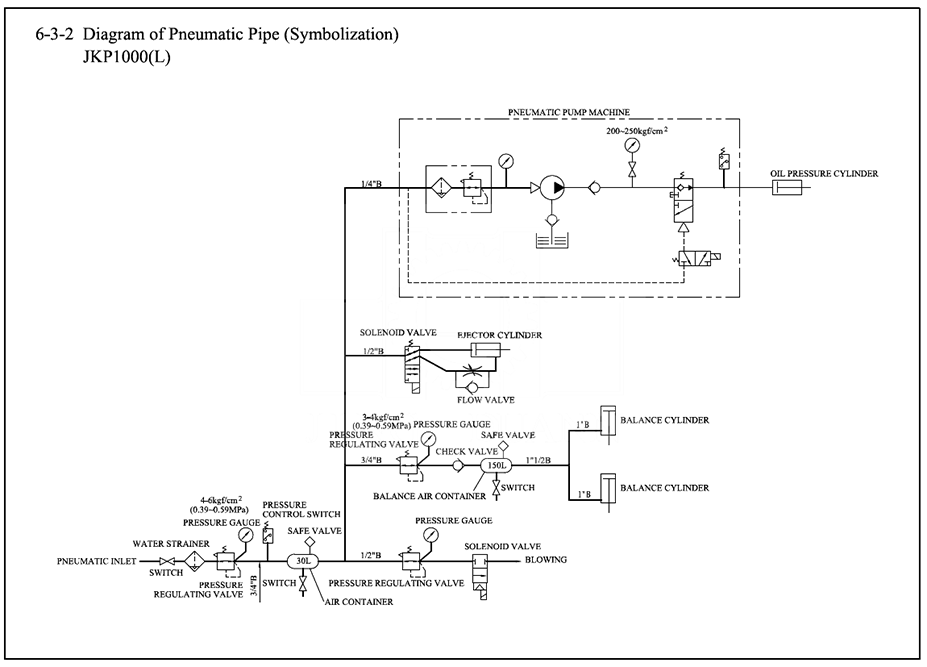
Sample air schematic diagram showing pressure regulators, filters, and distribution system for mechanical press maintenance
Sample Air Schematic  |  Reference diagram for press air system inspection

How often should air supply tanks be drained?

Weekly, minimum. Condensation accumulates in the tank and downstream contaminates filters, regulators, lubricators, and the rotary swivel air inlet at the clutch and brake unit. Water in the air line is the single most common root cause of premature CB lining failure on dry systems and air valve corrosion across the press.

What happens when air pressure drops below factory spec?

The ACB undercounterbalances the slide. The clutch and brake response slows. The HOLP system loses sensitivity. The result is hammering at the connection points, cracked pins, deformed couplings, and over time a distorted slide. The electronic pressure switch should trip and prevent operation, but only if it is functioning and correctly set.

What should be inspected on every weekly air system walk?

Verify no-leak condition throughout the line. Check inline filter element condition, lubricator oil level, pressure regulator settings against the press schematic, and pressure switch trip point. Inspect quick-connect outlets, dual valves with mufflers on the CB unit, air-line hoses, and connection fittings. Drain surge tanks. Confirm air supply lockable dump valve is operating.
Failure Threshold
Air leak detectable by sound or soap test → Tag and repair before next shift
System 02 of 11

ACB Systems. The Most Overlooked System on the Floor.

The Air Counter-Balance supports the weight of the upper die and slide. Set correctly, it allows lubrication to circulate to drive bearings and bushings during the stroke. Set incorrectly, it transmits every die change into a hammering load on the drive system. ACB is the most consistently mismanaged system on stamping presses, primarily because resetting pressure for each new die requires discipline that production schedules tend to override.
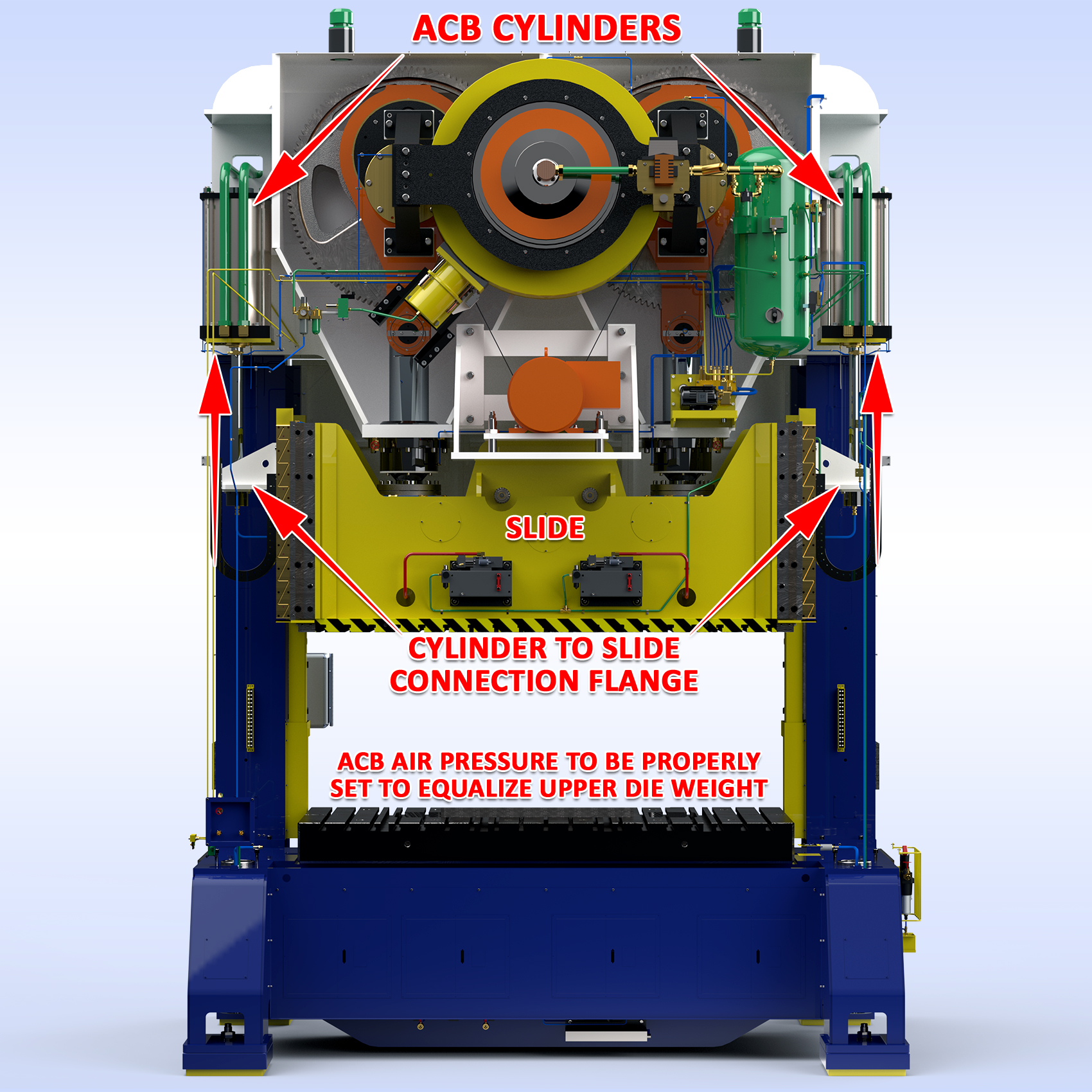
ACB system components showing air counter-balance cylinders and pressure gauges for press maintenance
ACB System Components  |  Slide, upper die weight, and ACB air center

What is the difference between static and dynamic ACB load?

Static load is the upper die and slide weight when the press is at rest. Dynamic load is what the ACB experiences during stroke at running SPM. ACB pressure must accommodate both: low enough to allow drive lubrication, high enough that the inertia at top and bottom dead center does not transfer to the drive train as a jackhammer effect on bearings, bushings, slide adjustment, hydraulic overload, and gear backlash.

How do you verify ACB pressure is set correctly?

Watch the main motor amp gauge during operation. Properly set ACB pressure produces minimal amp fluctuation. Heavy fluctuation indicates the ACB is undersupporting the slide and the motor is doing work the ACB should be doing. A consistently elevated amp reading indicates the ACB is overcompressing and the motor is fighting it. Mark the upper die with measured weight and reset ACB pressure on every changeover.

What are the symptoms of an ACB leak?

Visual scoring marks on the rods connecting cylinders to the slide indicate seal or packing damage. Pressure that drops between shifts indicates seal leak. Audible hissing at the cylinder confirms it. Never open ACB cylinders unless all air is drained from the press and lockout/tagout procedures are in effect.
Setting Discipline
Upper die weight known and marked → ACB pressure reset every die change
Got Questions Walking the Floor?
Eighty years of press answers. One phone call.
Call +1 (310) 453-6981
System 03 of 11

Clutch & Brake. Where Safety Lives.

The clutch and brake unit converts continuous rotational energy from the flywheel into the controlled stroke and stop the operator sees. There are two configurations in service: dry air systems using friction lining plates and air pressure, and wet systems using oil-cooled lining plates and hydraulic actuation. Both fail catastrophically when neglected. Failure modes are different. Maintenance protocols are different. Personnel safety implications are identical.
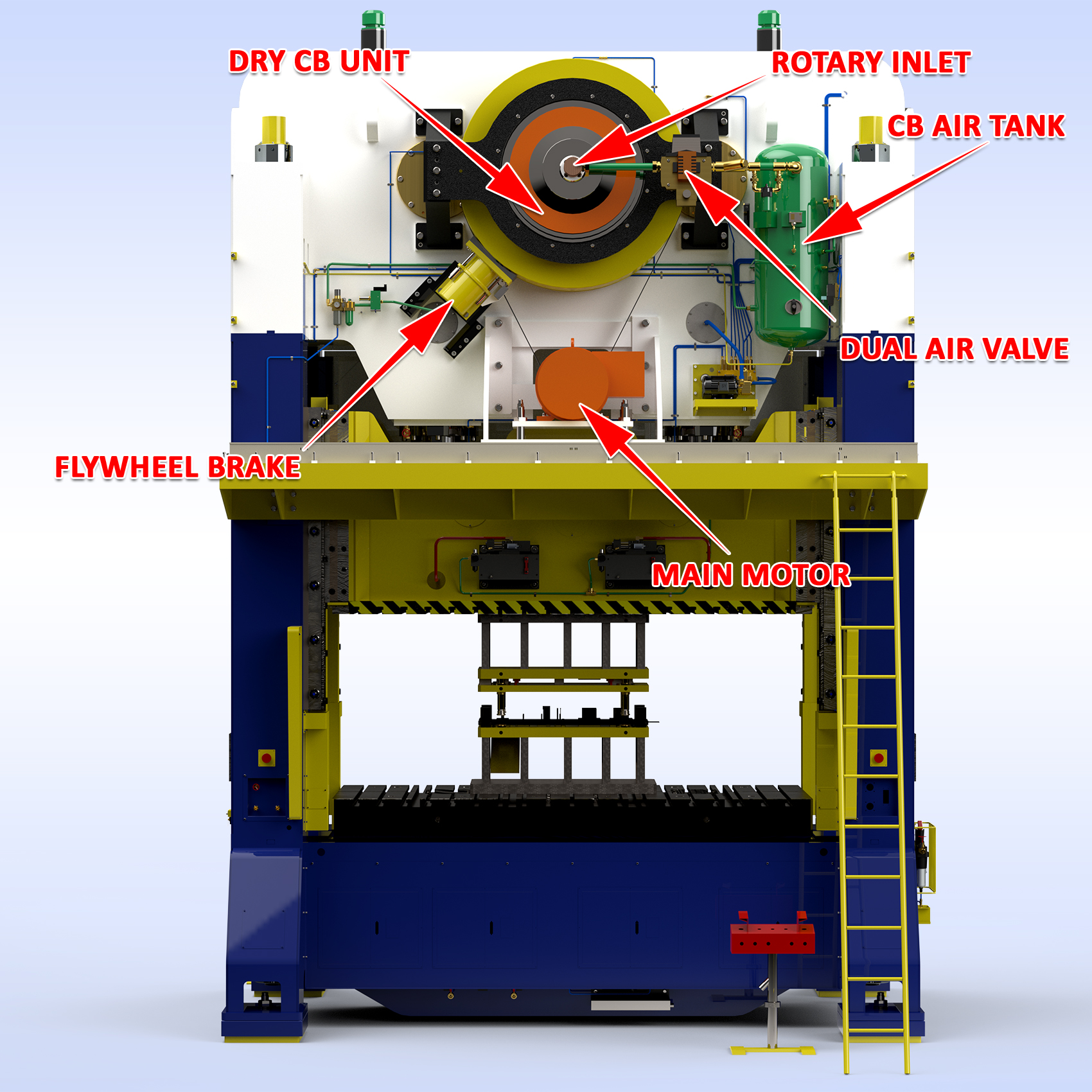
Dry clutch and brake system components showing friction plates and air pressure mechanisms for mechanical press maintenance
Dry Clutch & Brake System  |  Friction plates and air actuation components

How should single-stroke mode behave on a healthy press?

The slide should always stop near Top Dead Center. Stopping short of TDC, drifting past TDC, or inconsistent stop position between strokes indicates clutch or brake lining wear, air pressure variance, or a delayed valve response. In inch mode the slide should move with smooth, responsive engagement. In continuous mode the emergency stop should engage instantly. If any of these tests fail, the press should not run production until the cause is identified.

What is the weekly inspection routine for dry clutch and brake?

Drain all air supply tanks. Clean exhaust mufflers on electronically controlled clutch valves to prevent blockage. Inspect the full die area before activation and confirm point-of-operation guards are in place. Test inch mode, single stroke, continuous, and emergency stop in sequence. Examine flywheel brake travel monthly and replace pads before they glaze or thin.

What is different about wet clutch and brake maintenance?

Oil cleanliness is everything. Wet systems use oil for cooling and lubrication, which gives them better heat tolerance under heavy duty cycles. The tradeoff is hydraulic complexity. Monitor oil level and clarity weekly. Replace oil on the manufacturer schedule and analyze samples if production is heavy or contamination is suspected. Never mix oil types. Never overfill. Inspect all hydraulic and lube circuits for leaks. Check pad and plate thickness on schedule and replace before warping occurs.
Critical Test
Emergency stop in continuous mode → Instant engagement or remove from service
System 04 of 11

Connection Points. Where the Bill Comes Due.

The drive train transfers energy from main motor to slide through four sequential connections: motor to flywheel coupling, flywheel to clutch, clutch to crankshaft, crankshaft to ram. Each connection is where the consequences of the previous three systems show up. Wrong ACB pressure hammers these connections. Sluggish clutch response snaps them. Reverse tonnage from blanking releases stored energy back through them in milliseconds. The connection points do not generate problems. They absorb them.
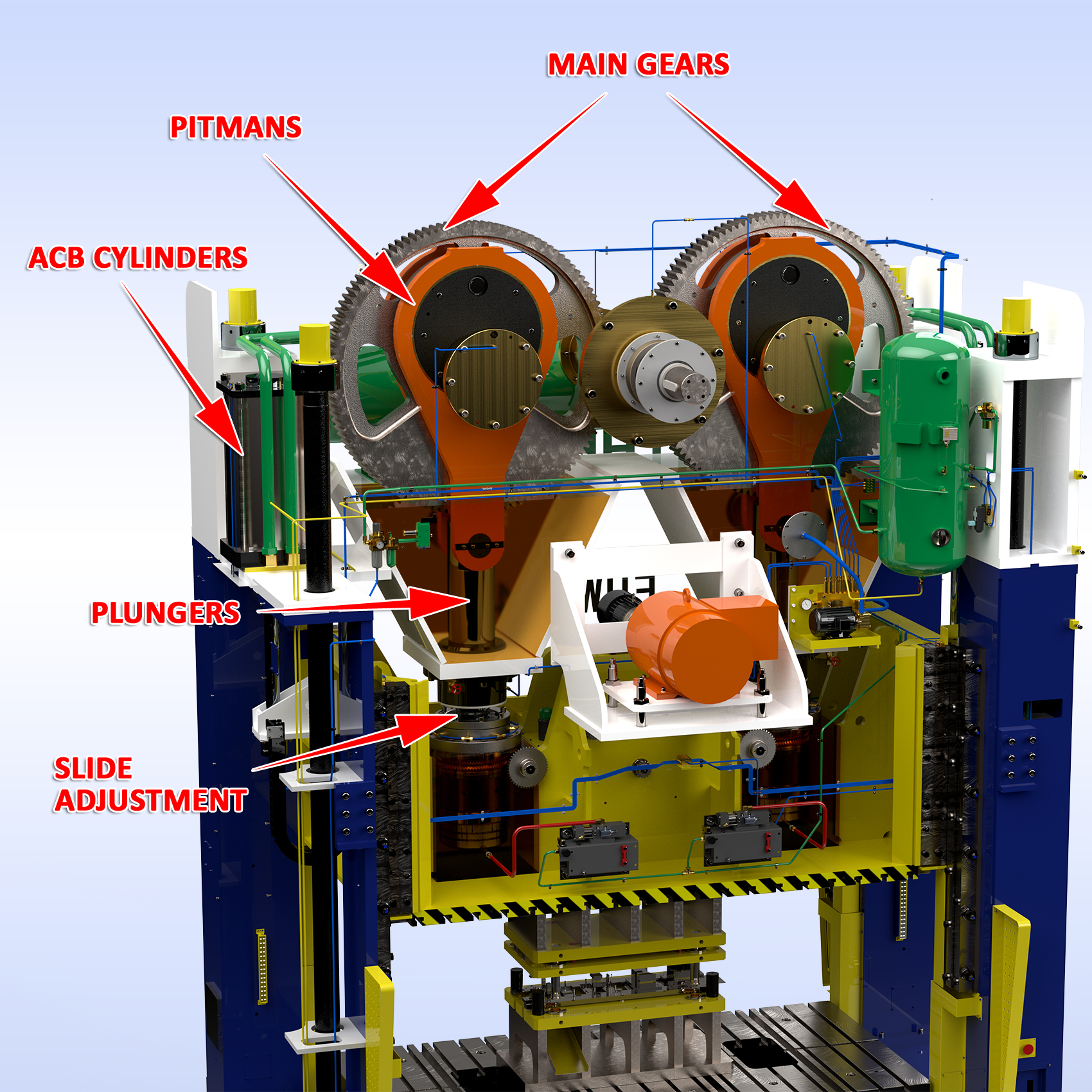
Drive system components diagram illustrating critical connection points for mechanical press maintenance
Drive System Components  |  Motor coupling, flywheel, clutch, crankshaft, ram linkage

What is snap-through tonnage and what threshold is safe?

Snap-through (reverse) tonnage is the energy released when a blank separates from the coil. Stored deformation energy releases instantly and travels back through the drive train as a shock load. The safe threshold is under 10% of press capacity. The 10-15% range is the caution zone. 20% or greater is the red zone, and every drive component above the bolster is paying for it on every stroke. Use electronic tonnage monitoring to catch excursions in real time.

How do ACB and HOLP work together on the drive system?

ACB counterbalances the upper tool weight to reduce hammering on the connection points during normal operation. HOLP protects against overloads above 110% of press capacity by releasing pressure and freeing a stuck die before mechanical damage occurs. Both must be set correctly for each die. One universal setting across all jobs is unsafe. ACB and HOLP are independent systems with separate setpoints, and both should be verified at every changeover.

What should be inspected on the connection points themselves?

Motor-to-flywheel coupling: alignment, torque, wear. Flywheel-to-clutch: engagement responsiveness, energy transfer efficiency. Clutch-to-crankshaft: backlash, slack. Crankshaft-to-ram: connecting rod fatigue, force consistency. Scoring, cracks, deformation, or impact-fatigue evidence on any of the four indicates upstream system failure. Inspect the connections, then inspect what caused the damage.
Reverse Tonnage Zones
Under 10%: Safe  |  10-15%: Caution  |  20%+: Red Zone
Part 1 / The Foundation

Weekly Inspection Checklist. Print and Walk the Floor.

  • WeeklyDrain all air supply tanks to remove condensation and moisture
  • WeeklyVerify no-leak condition on every fitting, hose, and connection in the air system
  • WeeklyCheck pressure regulator settings against factory schematic and pressure switch trip point
  • Per DieReset ACB pressure for measured upper die weight, marked on the die
  • Per ShiftVerify main motor amp gauge shows minimal fluctuation during operation
  • Per ShiftTest single-stroke stop position at or near Top Dead Center
  • Per ShiftTest emergency stop in continuous mode for instant engagement
  • WeeklyClean exhaust mufflers on electronically controlled clutch valves
  • MonthlyInspect flywheel brake travel and replace thin or glazed pads
  • WeeklyInspect ACB rods for scoring marks indicating seal damage
  • Per JobVerify reverse tonnage under 10% of press capacity on blanking operations
  • Per DieConfirm HOLP setpoint matches die requirements, not a universal setting
  • QuarterlyInspect connection points for scoring, cracks, deformation, or fatigue

This checklist is one page of a thirteen-page audit form Sutherland service technicians run on every preventative maintenance visit. The full Sutherland PMP documents every finding with photographs and rates each item Red, Yellow, or Green. The same methodology is what kept a Fortune 100 customer running 107 million strokes across five years with zero unplanned downtime.

Why It Matters

What Disciplined Foundation Maintenance Buys You. Every Shift.

01

Less Unplanned Downtime

Catch drift in air, ACB, and clutch pressure during weekly walks, not during a production run. A drained surge tank costs ninety seconds. A blown clutch costs three shifts.

02

Longer Drive Train Life

The motor coupling, flywheel, clutch, and crankshaft connections absorb every error in the systems upstream. Correct ACB pressure and clean clutch response keep them out of the repair queue.

03

Safer Operator Environment

Single stroke that stops at Top Dead Center. Emergency stop that engages instantly. These are not nice-to-haves. They are the difference between a good shift and an OSHA incident.

04

Predictable Die Life

Reverse tonnage under 10% of press capacity. ACB set for measured upper die weight. Hammering and shock loads are what shorten die life. Eliminate the hammering, extend the tooling.

05

Repeatable Quality

A press that delivers consistent tonnage on consistent strokes makes consistent parts. Foundation discipline is the floor that everything downstream is built on.

06

Lower Total Cost of Ownership

A small ACB leak caught in inspection costs a seal. A blown ACB cylinder caught after the fact costs a teardown, a rebuild, and the production behind it. The math is not subtle.

Key Takeaways

Four systems carry every stroke. Drain air tanks weekly. Reset ACB pressure for every die change. The slide should stop near Top Dead Center in single-stroke mode or the clutch needs attention. Reverse tonnage on blanking must stay under 10% of press capacity. If any one of these drifts, the connection points pay the bill, and the bill compounds.

Pressroom Engineering Consultation

Specify the Right Press. For Your Operation.

Whether you are evaluating a new press, planning a retrofit, or extending the life of equipment already on your floor, our engineering team will review your application, walk through configuration options, and help you identify the right specification for your production environment.

Same Business Day Response

< BACK TO SUTHERLAND NEWS

Sutherland Presses

THE FOUNDATION OF EVERY MECHANICAL PRESS: AIR, ACB, CLUTCH & BRAKE, CONNECTION POINTS

Sutherland Presses logo
Maintenance Reference | For Engineers and Maintenance Teams

Air, ACB, Clutch & Brake, Connection Points.
The Foundation of Every Mechanical Press.

Eighty percent of unplanned press downtime traces back to the four foundation systems below. Industry data places unplanned downtime at 23% of all lost production hours in forming and forging plants. The remediation is not a software upgrade or a control retrofit. It is a weekly maintenance cycle on systems that have not changed since the 1940s, executed with discipline. This article documents specific failure thresholds, inspection intervals, and the test methods Sutherland service technicians use on every preventative maintenance audit.

The four systems covered here are the foundation: air systems, the Air Counter-Balance (ACB), the clutch and brake unit, and the connection points that transfer drive energy from motor to slide. Every other system on the press depends on these four operating to factory specification. The full eleven-system reference is documented in the Sutherland Press Maintenance Tips.

23%
Unplanned DowntimeIndustry Average
110%
HOLP TriggerOf Press Capacity
10% max
Reverse TonnageOn Blanking Operations
System 01 of 11

Air Systems. The Pneumatic Backbone.

Air systems are crucial to mechanical presses and necessary on most servo hydraulic presses. They drive the clutch and brake, the air counter-balance, the HOLP overload protection, and (on hydraulic presses) the slide locking mechanism. Every press should be equipped with an electronically monitored air pressure switch that prevents press operation when supply pressure falls below the factory specification.

Sample air schematic diagram showing pressure regulators, filters, and distribution system for mechanical press maintenance
Sample Air Schematic  |  Reference diagram for press air system inspection

How often should air supply tanks be drained?

Weekly, minimum. Condensation accumulates in the tank and downstream contaminates filters, regulators, lubricators, and the rotary swivel air inlet at the clutch and brake unit. Water in the air line is the single most common root cause of premature CB lining failure on dry systems and air valve corrosion across the press.

What happens when air pressure drops below factory spec?

The ACB undercounterbalances the slide. The clutch and brake response slows. The HOLP system loses sensitivity. The result is hammering at the connection points, cracked pins, deformed couplings, and over time a distorted slide. The electronic pressure switch should trip and prevent operation, but only if it is functioning and correctly set.

What should be inspected on every weekly air system walk?

Verify no-leak condition throughout the line. Check inline filter element condition, lubricator oil level, pressure regulator settings against the press schematic, and pressure switch trip point. Inspect quick-connect outlets, dual valves with mufflers on the CB unit, air-line hoses, and connection fittings. Drain surge tanks. Confirm air supply lockable dump valve is operating.
Failure Threshold
Air leak detectable by sound or soap test → Tag and repair before next shift
System 02 of 11

ACB Systems. The Most Overlooked System on the Floor.

The Air Counter-Balance supports the weight of the upper die and slide. Set correctly, it allows lubrication to circulate to drive bearings and bushings during the stroke. Set incorrectly, it transmits every die change into a hammering load on the drive system. ACB is the most consistently mismanaged system on stamping presses, primarily because resetting pressure for each new die requires discipline that production schedules tend to override.

ACB system components showing air counter-balance cylinders and pressure gauges for press maintenance
ACB System Components  |  Slide, upper die weight, and ACB air center

What is the difference between static and dynamic ACB load?

Static load is the upper die and slide weight when the press is at rest. Dynamic load is what the ACB experiences during stroke at running SPM. ACB pressure must accommodate both: low enough to allow drive lubrication, high enough that the inertia at top and bottom dead center does not transfer to the drive train as a jackhammer effect on bearings, bushings, slide adjustment, hydraulic overload, and gear backlash.

How do you verify ACB pressure is set correctly?

Watch the main motor amp gauge during operation. Properly set ACB pressure produces minimal amp fluctuation. Heavy fluctuation indicates the ACB is undersupporting the slide and the motor is doing work the ACB should be doing. A consistently elevated amp reading indicates the ACB is overcompressing and the motor is fighting it. Mark the upper die with measured weight and reset ACB pressure on every changeover.

What are the symptoms of an ACB leak?

Visual scoring marks on the rods connecting cylinders to the slide indicate seal or packing damage. Pressure that drops between shifts indicates seal leak. Audible hissing at the cylinder confirms it. Never open ACB cylinders unless all air is drained from the press and lockout/tagout procedures are in effect.
Setting Discipline
Upper die weight known and marked → ACB pressure reset every die change
Got Questions Walking the Floor?
Eighty years of press answers. One phone call.
Call +1 (310) 453-6981
System 03 of 11

Clutch & Brake. Where Safety Lives.

The clutch and brake unit converts continuous rotational energy from the flywheel into the controlled stroke and stop the operator sees. There are two configurations in service: dry air systems using friction lining plates and air pressure, and wet systems using oil-cooled lining plates and hydraulic actuation. Both fail catastrophically when neglected. Failure modes are different. Maintenance protocols are different. Personnel safety implications are identical.

Dry clutch and brake system components showing friction plates and air pressure mechanisms for mechanical press maintenance
Dry Clutch & Brake System  |  Friction plates and air actuation components

How should single-stroke mode behave on a healthy press?

The slide should always stop near Top Dead Center. Stopping short of TDC, drifting past TDC, or inconsistent stop position between strokes indicates clutch or brake lining wear, air pressure variance, or a delayed valve response. In inch mode the slide should move with smooth, responsive engagement. In continuous mode the emergency stop should engage instantly. If any of these tests fail, the press should not run production until the cause is identified.

What is the weekly inspection routine for dry clutch and brake?

Drain all air supply tanks. Clean exhaust mufflers on electronically controlled clutch valves to prevent blockage. Inspect the full die area before activation and confirm point-of-operation guards are in place. Test inch mode, single stroke, continuous, and emergency stop in sequence. Examine flywheel brake travel monthly and replace pads before they glaze or thin.

What is different about wet clutch and brake maintenance?

Oil cleanliness is everything. Wet systems use oil for cooling and lubrication, which gives them better heat tolerance under heavy duty cycles. The tradeoff is hydraulic complexity. Monitor oil level and clarity weekly. Replace oil on the manufacturer schedule and analyze samples if production is heavy or contamination is suspected. Never mix oil types. Never overfill. Inspect all hydraulic and lube circuits for leaks. Check pad and plate thickness on schedule and replace before warping occurs.
Critical Test
Emergency stop in continuous mode → Instant engagement or remove from service
System 04 of 11

Connection Points. Where the Bill Comes Due.

The drive train transfers energy from main motor to slide through four sequential connections: motor to flywheel coupling, flywheel to clutch, clutch to crankshaft, crankshaft to ram. Each connection is where the consequences of the previous three systems show up. Wrong ACB pressure hammers these connections. Sluggish clutch response snaps them. Reverse tonnage from blanking releases stored energy back through them in milliseconds. The connection points do not generate problems. They absorb them.

Drive system components diagram illustrating critical connection points for mechanical press maintenance
Drive System Components  |  Motor coupling, flywheel, clutch, crankshaft, ram linkage

What is snap-through tonnage and what threshold is safe?

Snap-through (reverse) tonnage is the energy released when a blank separates from the coil. Stored deformation energy releases instantly and travels back through the drive train as a shock load. The safe threshold is under 10% of press capacity. The 10-15% range is the caution zone. 20% or greater is the red zone, and every drive component above the bolster is paying for it on every stroke. Use electronic tonnage monitoring to catch excursions in real time.

How do ACB and HOLP work together on the drive system?

ACB counterbalances the upper tool weight to reduce hammering on the connection points during normal operation. HOLP protects against overloads above 110% of press capacity by releasing pressure and freeing a stuck die before mechanical damage occurs. Both must be set correctly for each die. One universal setting across all jobs is unsafe. ACB and HOLP are independent systems with separate setpoints, and both should be verified at every changeover.

What should be inspected on the connection points themselves?

Motor-to-flywheel coupling: alignment, torque, wear. Flywheel-to-clutch: engagement responsiveness, energy transfer efficiency. Clutch-to-crankshaft: backlash, slack. Crankshaft-to-ram: connecting rod fatigue, force consistency. Scoring, cracks, deformation, or impact-fatigue evidence on any of the four indicates upstream system failure. Inspect the connections, then inspect what caused the damage.
Reverse Tonnage Zones
Under 10%: Safe  |  10-15%: Caution  |  20%+: Red Zone
Part 1 / The Foundation

Weekly Inspection Checklist. Print and Walk the Floor.

  • WeeklyDrain all air supply tanks to remove condensation and moisture
  • WeeklyVerify no-leak condition on every fitting, hose, and connection in the air system
  • WeeklyCheck pressure regulator settings against factory schematic and pressure switch trip point
  • Per DieReset ACB pressure for measured upper die weight, marked on the die
  • Per ShiftVerify main motor amp gauge shows minimal fluctuation during operation
  • Per ShiftTest single-stroke stop position at or near Top Dead Center
  • Per ShiftTest emergency stop in continuous mode for instant engagement
  • WeeklyClean exhaust mufflers on electronically controlled clutch valves
  • MonthlyInspect flywheel brake travel and replace thin or glazed pads
  • WeeklyInspect ACB rods for scoring marks indicating seal damage
  • Per JobVerify reverse tonnage under 10% of press capacity on blanking operations
  • Per DieConfirm HOLP setpoint matches die requirements, not a universal setting
  • QuarterlyInspect connection points for scoring, cracks, deformation, or fatigue

This checklist is one page of a thirteen-page audit form Sutherland service technicians run on every preventative maintenance visit. The full Sutherland PMP documents every finding with photographs and rates each item Red, Yellow, or Green. The same methodology is what kept a Fortune 100 customer running 107 million strokes across five years with zero unplanned downtime.

Why It Matters

What Disciplined Foundation Maintenance Buys You. Every Shift.

01

Less Unplanned Downtime

Catch drift in air, ACB, and clutch pressure during weekly walks, not during a production run. A drained surge tank costs ninety seconds. A blown clutch costs three shifts.

02

Longer Drive Train Life

The motor coupling, flywheel, clutch, and crankshaft connections absorb every error in the systems upstream. Correct ACB pressure and clean clutch response keep them out of the repair queue.

03

Safer Operator Environment

Single stroke that stops at Top Dead Center. Emergency stop that engages instantly. These are not nice-to-haves. They are the difference between a good shift and an OSHA incident.

04

Predictable Die Life

Reverse tonnage under 10% of press capacity. ACB set for measured upper die weight. Hammering and shock loads are what shorten die life. Eliminate the hammering, extend the tooling.

05

Repeatable Quality

A press that delivers consistent tonnage on consistent strokes makes consistent parts. Foundation discipline is the floor that everything downstream is built on.

06

Lower Total Cost of Ownership

A small ACB leak caught in inspection costs a seal. A blown ACB cylinder caught after the fact costs a teardown, a rebuild, and the production behind it. The math is not subtle.

Key Takeaways

Four systems carry every stroke. Drain air tanks weekly. Reset ACB pressure for every die change. The slide should stop near Top Dead Center in single-stroke mode or the clutch needs attention. Reverse tonnage on blanking must stay under 10% of press capacity. If any one of these drifts, the connection points pay the bill, and the bill compounds.

Pressroom Engineering Consultation

Specify the Right Press. For Your Operation.

Whether you are evaluating a new press, planning a retrofit, or extending the life of equipment already on your floor, our engineering team will review your application, walk through configuration options, and help you identify the right specification for your production environment.

Same Business Day Response

Heading

Heading

Lorem ipsum dolor sit amet, consectetur adipiscing elit. Suspendisse varius enim in eros elementum tristique. Duis cursus, mi quis viverra ornare, eros dolor interdum nulla, ut commodo diam libero vitae erat. Aenean faucibus nibh et justo cursus id rutrum lorem imperdiet. Nunc ut sem vitae risus tristique posuere.

back to news >

SUTHERLAND CLIENTS

REQUEST A QUOTE