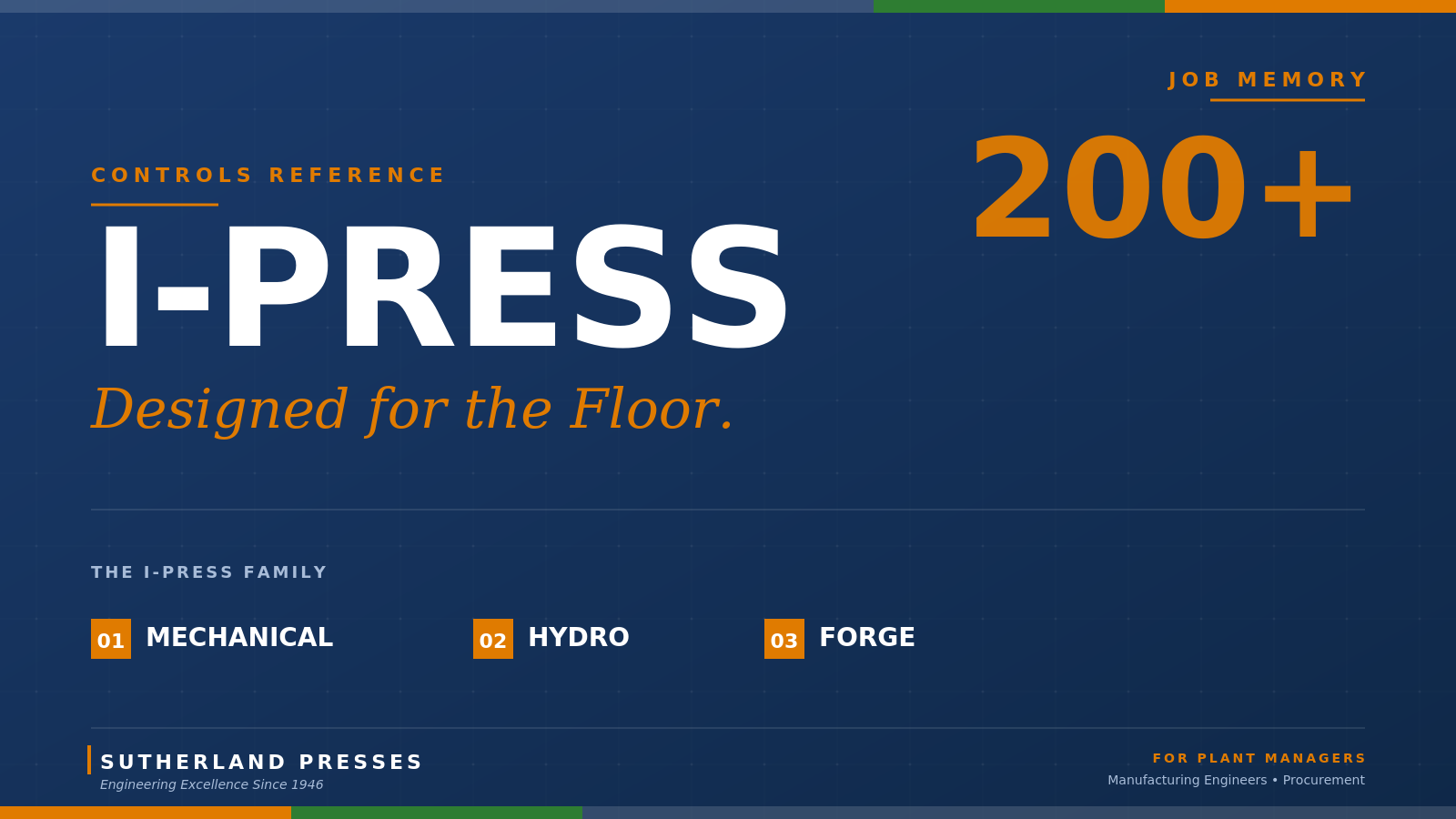
MODERN CONTROLS BUILT FOR THE FLOOR: HOW I-PRESS WORKS

May 15, 2026
Industry News
Sutherland Presses logo
Controls Reference | For Plant Managers and Manufacturing Engineers

Modern Controls for Modern Manufacturing.
Designed for the Floor. Not the Brochure.

Most press control systems carry architecture decisions made decades ago. Legacy compatibility requirements, workarounds for older hardware, safety models built around outdated workflows. Every generation adds more buttons, more menus, more screens nobody on the floor actually uses. The result is a control designed by committee where finding the right screen takes three taps instead of one, implementation takes weeks instead of days, and training becomes a project instead of an orientation.

I-PRESS was built differently. Designed from first principles around one question: what does an operator actually need on a modern press. The answer became the platform. Not as add-ons bolted onto a legacy system, but as the foundation. Try the live I-PRESS simulator to see what intuitive control design looks like.

Sutherland I-PRESS family of press controls including mechanical, hydraulic, and forge variants
The I-PRESS Family  |  Software-based controls and HD color touchscreen displays across mechanical, hydraulic, and forge press platforms
200jobs
Job MemoryStored Production Profiles
130monitors
Function MonitoringDiscrete Press Functions
1shift
Operator CompetencyTime to Productive Use
Design Principle 01

Purpose-Built. Not Over-Specified.

A control system inherits everything that came before it. Every legacy compatibility feature, every workaround, every screen built for a press model retired ten years ago. I-PRESS rejects that default. Every capability on the interface is there because a user asked for it. Legacy compatibility modes that nobody uses in 2026 are not on the screen. The result is a control an experienced operator can navigate without a reference guide and a new operator can learn in a single shift.

Sutherland I-PRESS PLUS control for mechanical stamping press with 9 inch and 10 inch HD color touchscreen
I-PRESS PLUS  |  Mechanical press control with 9" and 10" HD color touchscreen, Allen-Bradley and Omron platforms

Why does control complexity matter on the production floor?

Complexity costs in three places. Operator productivity drops when mental effort goes into navigating menus instead of optimizing the cycle. Implementation timelines stretch when oversized feature sets require more configuration and validation before production. Failure surface area expands as every additional programmable input becomes a potential point of failure. Simpler systems have fewer things to break and clearer paths to fix what does break.

What features does I-PRESS include that legacy controls do not?

I-PRESS ships with 200+ job memory profiles, twelve programmable cams, 130 discrete function monitors, and Ethernet/IP enterprise connectivity built in. Standard legacy architecture typically tops out at 50 stored jobs with cam count limited by the control hardware itself. Enterprise connectivity on legacy platforms generally requires bolt-on modules and a separate integration project. On I-PRESS those capabilities are the foundation, not an add-on.

How does I-PRESS handle operator-specific access and safety?

Three access levels: operator, setter, and maintenance. Each level is restricted to the functions appropriate to the role. The safety circuit, mode selector, and point-of-operation guards integrate with the control rather than running parallel to it. Modifying the safety logic requires written approval from the press builder, the same standard documented in the maintenance reference for every Sutherland press.
Setup Time Comparison
First production run on I-PRESS → 2 to 3 hours  |  Legacy comparable → 2 to 3 days
Design Principle 02

Transparent Operation. No Hidden Layers.

The control either tells the operator what is happening or it does not. Legacy designs hide diagnostic information behind menu paths that require a service manual to decode. I-PRESS shows the operator cycle status, die monitor states, performance metrics, and fault codes with plain-language explanations on the working screen. There is no diagnostic mode to enter, no service code to look up. The information that determines the next operator decision is visible at the time that decision needs to be made.

Sutherland I-PRESS HYDRO control system for hydraulic stamping presses with 10 inch HD touchscreen
I-PRESS HYDRO  |  Hydraulic press control with 10" HD touchscreen, 200+ job memory, and step-by-step fault diagnostics

What does the operator see during a normal production cycle?

Live SPM, current job profile, active die monitors with their status, motor amp draw, tonnage signature on the last stroke, and any active or recent fault codes. Cycle counts, scheduled maintenance intervals, and shift production metrics are accessible in one tap. The same screen that runs the press is the screen that reports on it. No mode change required to check production data.

How does I-PRESS handle fault diagnostics?

Step-by-step fault logic. When a fault occurs the control names the failed component, identifies the contributing condition, and suggests the verified corrective action. A stuck slide trips the HOLP fault and the screen displays the HOLP status, the ACB pressure reading, the last tonnage value, and the recommended inspection sequence. The operator does not navigate to find this information. The control surfaces it because the fault requires it.

Can supervisors see press performance without walking the floor?

Yes. Ethernet/IP connectivity is built in, not added on. Production data, fault history, cycle counts, and OEE metrics export to enterprise systems in real time. Remote monitoring connects to MES, ERP, or independent dashboards. Plant managers can see what every press is doing from a single screen without operator action required.
Operator Training Comparison
I-PRESS to competency → 1 shift  |  Legacy control to competency → 2 to 4 weeks
Try Before You Buy
Run I-PRESS in your browser. No login. No sales call.
Launch the Simulator
From the Floor

"Press control systems used to require operator workarounds and reference manuals for basic diagnostics. I-PRESS shows you what is happening, why it is happening, and what to do about it. On the screen, in plain language. The shift in operator confidence is immediate."

Plant Engineer  ·  Tier 1 Automotive Stamping Operation
Design Principle 03

Enterprise-Ready. From Day One.

Modern manufacturing is connected. The press control either ships ready to talk to the rest of the plant or it requires a retrofit project to get there. I-PRESS ships with Ethernet/IP, OPC-UA, and integration hooks for feeders, robots, and transfer systems. The press becomes a participating node on the manufacturing network the day it goes live, not the day someone schedules the integration phase. That single design choice removes weeks from the implementation timeline and removes a recurring class of integration risk.

Sutherland I-PRESS FORGE control system for forge presses with 15 inch HD touchscreen and thermal bearing sensors
I-PRESS FORGE  |  Forge press control with 15" HD touchscreen, 500+ job memory, thermal bearing sensors, and billet temperature monitoring

What enterprise systems does I-PRESS connect to?

Standard MES and ERP platforms over Ethernet/IP. OPC-UA for plant-wide manufacturing intelligence. Direct integration hooks for upstream coil feeders, downstream conveyance, robotic transfer systems, and stacker/destacker equipment. Sutherland presses with I-PRESS have been deployed in tandem lines with full crossbar transfer automation under a single control architecture, including the six-press 800-ton tandem line concept currently in development for automotive stamping.

Does enterprise connectivity require additional licensing or hardware?

No. Ethernet/IP and OPC-UA are standard on every I-PRESS configuration. Remote monitoring is built into the platform. Additional licenses, conversion modules, or bolt-on connectivity hardware are not part of the I-PRESS specification. The control ships ready for the network the customer already runs.

How does I-PRESS handle changeover and job memory across a production line?

200+ job profiles stored locally on each press. RFID die identification triggers an automatic recipe load across the entire line on die change. Slide position, counterbalance pressure, transfer parameters, and die monitor configurations all load from the recipe with no operator entry required. The same architecture supports automated changeover in tandem line configurations where a single recipe load configures six presses simultaneously.
Enterprise Connectivity
Ethernet/IP, OPC-UA, MES integration → Built in, day one  |  No retrofit project required
I-PRESS Capabilities

What Ships Standard. Every Configuration, Every Press.

  • Operator200+ job memory profiles with full recipe storage and RFID-triggered auto-load
  • Operator12 programmable cams independently configurable per job
  • Operator130 discrete function monitors across all press systems and auxiliary equipment
  • OperatorLive tonnage signature on every stroke with high and low limit alarms
  • OperatorStep-by-step fault diagnostics with plain-language corrective actions
  • SetterThree access levels with role-appropriate function restriction
  • SetterSlide position automation with counterbalance pressure auto-set per recipe
  • Setter16 die monitors with named sensor configuration and individual threshold settings per job
  • NetworkEthernet/IP connectivity for MES, ERP, and remote monitoring as standard
  • NetworkOPC-UA support for plant-wide manufacturing intelligence platforms
  • NetworkAutomation integration with feeders, robots, transfer systems, stackers
  • SafetyPL-d / Cat-3 safety circuit integrated with mode selector and point-of-operation guards
  • SafetyLockout-tagout integration with control state tracking for audit traceability

The full I-PRESS specification is documented at the I-PRESS controls page. The simulator is available at ui-construct.com/I-PRESS/PanelViewPlus.html with no login required.

Why It Matters

What Intuitive Control Design Buys You. Every Shift.

01

Faster Operator Ramp

Operators productive within a single shift instead of weeks of training. New hires reach competency on I-PRESS before legacy platforms finish their first day of orientation.

02

Lower Support Overhead

Intuitive design means fewer operator support calls. The control answers the question on screen. Maintenance and engineering recover the hours they were spending on interface training.

03

Reduced Unplanned Downtime

Step-by-step fault diagnostics shrink the time between a fault code and a fixed press. Plain-language explanations replace service-manual lookups at the worst possible moment.

04

Faster Changeover

200 stored jobs and RFID-triggered recipe loading turn die change from a 90-minute setup into a 10 to 15 minute reset. The line returns to production while the legacy press is still warming up.

05

Better Production Data

Ethernet/IP and OPC-UA built in mean real-time visibility into press performance from anywhere on the network. Plant managers see OEE without walking the floor.

06

Lower Implementation Risk

Production-ready out of the crate. Integration hooks for feeders, robots, and transfer systems are foundational, not bolted on. Implementation timelines shrink and integration risk drops with them.

Key Takeaways

Real control innovation makes operators' jobs easier, not harder. If the system requires an expert to explain it, it was designed for a different era. I-PRESS ships production-ready with 200 jobs, 12 programmable cams, 130 monitors, and Ethernet/IP enterprise connectivity as standard. Operators reach competency in a single shift, setup runs in hours instead of days, and integration with feeders, robots, and transfer systems is foundational, not retrofitted. Modern manufacturing deserves a control as intuitive as a smartphone, as transparent as a spreadsheet, and as connected as the rest of the enterprise.

I-PRESS Engineering Consultation

See I-PRESS Running. On Your Production Floor.

Whether you are specifying a new press, evaluating a control retrofit, or comparing I-PRESS against another platform on an active RFQ, our engineering team will walk you through the configuration options that fit your application and your operators. Try the live simulator first. Then talk to an engineer.

Same Business Day Response

< BACK TO SUTHERLAND NEWS

Sutherland Presses

MODERN CONTROLS BUILT FOR THE FLOOR: HOW I-PRESS WORKS

Sutherland Presses logo
Controls Reference | For Plant Managers and Manufacturing Engineers

Modern Controls for Modern Manufacturing.
Designed for the Floor. Not the Brochure.

Most press control systems carry architecture decisions made decades ago. Legacy compatibility requirements, workarounds for older hardware, safety models built around outdated workflows. Every generation adds more buttons, more menus, more screens nobody on the floor actually uses. The result is a control designed by committee where finding the right screen takes three taps instead of one, implementation takes weeks instead of days, and training becomes a project instead of an orientation.

I-PRESS was built differently. Designed from first principles around one question: what does an operator actually need on a modern press. The answer became the platform. Not as add-ons bolted onto a legacy system, but as the foundation. Try the live I-PRESS simulator to see what intuitive control design looks like.

Sutherland I-PRESS family of press controls including mechanical, hydraulic, and forge variants
The I-PRESS Family  |  Software-based controls and HD color touchscreen displays across mechanical, hydraulic, and forge press platforms
200jobs
Job MemoryStored Production Profiles
130monitors
Function MonitoringDiscrete Press Functions
1shift
Operator CompetencyTime to Productive Use
Design Principle 01

Purpose-Built. Not Over-Specified.

A control system inherits everything that came before it. Every legacy compatibility feature, every workaround, every screen built for a press model retired ten years ago. I-PRESS rejects that default. Every capability on the interface is there because a user asked for it. Legacy compatibility modes that nobody uses in 2026 are not on the screen. The result is a control an experienced operator can navigate without a reference guide and a new operator can learn in a single shift.

Sutherland I-PRESS PLUS control for mechanical stamping press with 9 inch and 10 inch HD color touchscreen
I-PRESS PLUS  |  Mechanical press control with 9" and 10" HD color touchscreen, Allen-Bradley and Omron platforms

Why does control complexity matter on the production floor?

Complexity costs in three places. Operator productivity drops when mental effort goes into navigating menus instead of optimizing the cycle. Implementation timelines stretch when oversized feature sets require more configuration and validation before production. Failure surface area expands as every additional programmable input becomes a potential point of failure. Simpler systems have fewer things to break and clearer paths to fix what does break.

What features does I-PRESS include that legacy controls do not?

I-PRESS ships with 200+ job memory profiles, twelve programmable cams, 130 discrete function monitors, and Ethernet/IP enterprise connectivity built in. Standard legacy architecture typically tops out at 50 stored jobs with cam count limited by the control hardware itself. Enterprise connectivity on legacy platforms generally requires bolt-on modules and a separate integration project. On I-PRESS those capabilities are the foundation, not an add-on.

How does I-PRESS handle operator-specific access and safety?

Three access levels: operator, setter, and maintenance. Each level is restricted to the functions appropriate to the role. The safety circuit, mode selector, and point-of-operation guards integrate with the control rather than running parallel to it. Modifying the safety logic requires written approval from the press builder, the same standard documented in the maintenance reference for every Sutherland press.
Setup Time Comparison
First production run on I-PRESS → 2 to 3 hours  |  Legacy comparable → 2 to 3 days
Design Principle 02

Transparent Operation. No Hidden Layers.

The control either tells the operator what is happening or it does not. Legacy designs hide diagnostic information behind menu paths that require a service manual to decode. I-PRESS shows the operator cycle status, die monitor states, performance metrics, and fault codes with plain-language explanations on the working screen. There is no diagnostic mode to enter, no service code to look up. The information that determines the next operator decision is visible at the time that decision needs to be made.

Sutherland I-PRESS HYDRO control system for hydraulic stamping presses with 10 inch HD touchscreen
I-PRESS HYDRO  |  Hydraulic press control with 10" HD touchscreen, 200+ job memory, and step-by-step fault diagnostics

What does the operator see during a normal production cycle?

Live SPM, current job profile, active die monitors with their status, motor amp draw, tonnage signature on the last stroke, and any active or recent fault codes. Cycle counts, scheduled maintenance intervals, and shift production metrics are accessible in one tap. The same screen that runs the press is the screen that reports on it. No mode change required to check production data.

How does I-PRESS handle fault diagnostics?

Step-by-step fault logic. When a fault occurs the control names the failed component, identifies the contributing condition, and suggests the verified corrective action. A stuck slide trips the HOLP fault and the screen displays the HOLP status, the ACB pressure reading, the last tonnage value, and the recommended inspection sequence. The operator does not navigate to find this information. The control surfaces it because the fault requires it.

Can supervisors see press performance without walking the floor?

Yes. Ethernet/IP connectivity is built in, not added on. Production data, fault history, cycle counts, and OEE metrics export to enterprise systems in real time. Remote monitoring connects to MES, ERP, or independent dashboards. Plant managers can see what every press is doing from a single screen without operator action required.
Operator Training Comparison
I-PRESS to competency → 1 shift  |  Legacy control to competency → 2 to 4 weeks
Try Before You Buy
Run I-PRESS in your browser. No login. No sales call.
Launch the Simulator
From the Floor

"Press control systems used to require operator workarounds and reference manuals for basic diagnostics. I-PRESS shows you what is happening, why it is happening, and what to do about it. On the screen, in plain language. The shift in operator confidence is immediate."

Plant Engineer  ·  Tier 1 Automotive Stamping Operation
Design Principle 03

Enterprise-Ready. From Day One.

Modern manufacturing is connected. The press control either ships ready to talk to the rest of the plant or it requires a retrofit project to get there. I-PRESS ships with Ethernet/IP, OPC-UA, and integration hooks for feeders, robots, and transfer systems. The press becomes a participating node on the manufacturing network the day it goes live, not the day someone schedules the integration phase. That single design choice removes weeks from the implementation timeline and removes a recurring class of integration risk.

Sutherland I-PRESS FORGE control system for forge presses with 15 inch HD touchscreen and thermal bearing sensors
I-PRESS FORGE  |  Forge press control with 15" HD touchscreen, 500+ job memory, thermal bearing sensors, and billet temperature monitoring

What enterprise systems does I-PRESS connect to?

Standard MES and ERP platforms over Ethernet/IP. OPC-UA for plant-wide manufacturing intelligence. Direct integration hooks for upstream coil feeders, downstream conveyance, robotic transfer systems, and stacker/destacker equipment. Sutherland presses with I-PRESS have been deployed in tandem lines with full crossbar transfer automation under a single control architecture, including the six-press 800-ton tandem line concept currently in development for automotive stamping.

Does enterprise connectivity require additional licensing or hardware?

No. Ethernet/IP and OPC-UA are standard on every I-PRESS configuration. Remote monitoring is built into the platform. Additional licenses, conversion modules, or bolt-on connectivity hardware are not part of the I-PRESS specification. The control ships ready for the network the customer already runs.

How does I-PRESS handle changeover and job memory across a production line?

200+ job profiles stored locally on each press. RFID die identification triggers an automatic recipe load across the entire line on die change. Slide position, counterbalance pressure, transfer parameters, and die monitor configurations all load from the recipe with no operator entry required. The same architecture supports automated changeover in tandem line configurations where a single recipe load configures six presses simultaneously.
Enterprise Connectivity
Ethernet/IP, OPC-UA, MES integration → Built in, day one  |  No retrofit project required
I-PRESS Capabilities

What Ships Standard. Every Configuration, Every Press.

  • Operator200+ job memory profiles with full recipe storage and RFID-triggered auto-load
  • Operator12 programmable cams independently configurable per job
  • Operator130 discrete function monitors across all press systems and auxiliary equipment
  • OperatorLive tonnage signature on every stroke with high and low limit alarms
  • OperatorStep-by-step fault diagnostics with plain-language corrective actions
  • SetterThree access levels with role-appropriate function restriction
  • SetterSlide position automation with counterbalance pressure auto-set per recipe
  • Setter16 die monitors with named sensor configuration and individual threshold settings per job
  • NetworkEthernet/IP connectivity for MES, ERP, and remote monitoring as standard
  • NetworkOPC-UA support for plant-wide manufacturing intelligence platforms
  • NetworkAutomation integration with feeders, robots, transfer systems, stackers
  • SafetyPL-d / Cat-3 safety circuit integrated with mode selector and point-of-operation guards
  • SafetyLockout-tagout integration with control state tracking for audit traceability

The full I-PRESS specification is documented at the I-PRESS controls page. The simulator is available at ui-construct.com/I-PRESS/PanelViewPlus.html with no login required.

Why It Matters

What Intuitive Control Design Buys You. Every Shift.

01

Faster Operator Ramp

Operators productive within a single shift instead of weeks of training. New hires reach competency on I-PRESS before legacy platforms finish their first day of orientation.

02

Lower Support Overhead

Intuitive design means fewer operator support calls. The control answers the question on screen. Maintenance and engineering recover the hours they were spending on interface training.

03

Reduced Unplanned Downtime

Step-by-step fault diagnostics shrink the time between a fault code and a fixed press. Plain-language explanations replace service-manual lookups at the worst possible moment.

04

Faster Changeover

200 stored jobs and RFID-triggered recipe loading turn die change from a 90-minute setup into a 10 to 15 minute reset. The line returns to production while the legacy press is still warming up.

05

Better Production Data

Ethernet/IP and OPC-UA built in mean real-time visibility into press performance from anywhere on the network. Plant managers see OEE without walking the floor.

06

Lower Implementation Risk

Production-ready out of the crate. Integration hooks for feeders, robots, and transfer systems are foundational, not bolted on. Implementation timelines shrink and integration risk drops with them.

Key Takeaways

Real control innovation makes operators' jobs easier, not harder. If the system requires an expert to explain it, it was designed for a different era. I-PRESS ships production-ready with 200 jobs, 12 programmable cams, 130 monitors, and Ethernet/IP enterprise connectivity as standard. Operators reach competency in a single shift, setup runs in hours instead of days, and integration with feeders, robots, and transfer systems is foundational, not retrofitted. Modern manufacturing deserves a control as intuitive as a smartphone, as transparent as a spreadsheet, and as connected as the rest of the enterprise.

I-PRESS Engineering Consultation

See I-PRESS Running. On Your Production Floor.

Whether you are specifying a new press, evaluating a control retrofit, or comparing I-PRESS against another platform on an active RFQ, our engineering team will walk you through the configuration options that fit your application and your operators. Try the live simulator first. Then talk to an engineer.

Same Business Day Response

Heading

Heading

Lorem ipsum dolor sit amet, consectetur adipiscing elit. Suspendisse varius enim in eros elementum tristique. Duis cursus, mi quis viverra ornare, eros dolor interdum nulla, ut commodo diam libero vitae erat. Aenean faucibus nibh et justo cursus id rutrum lorem imperdiet. Nunc ut sem vitae risus tristique posuere.

back to news >

SUTHERLAND CLIENTS

REQUEST A QUOTE