HYDRAULICS, LUBRICATION, I-PRESS, PMP: THE LIFECYCLE SYSTEMS OF EVERY MECHANICAL PRESS

May 17, 2026
Maintenance Tips
Sutherland Presses logo
Maintenance Reference | For Engineers and Maintenance Teams

Hydraulics, Lubrication, I-PRESS, & PMP.
The Lifecycle Systems That Protect Your Investment.

Foundation. Precision. Lifecycle. The three pillars of mechanical press reliability. The first two are about what happens in the stroke-air pressure, clutch engagement, slide alignment, load protection. The third is about what happens between strokes. Hydraulic fluid quality. Lubrication delivery. Control system upgrades. Scheduled inspections. These systems do not govern the press operation. They govern how long the press stays in operation. Neglect any one and the clock on equipment life accelerates.

The systems covered in this final reference are hydraulic fluid management, automated lubrication, I-PRESS control retrofits, and preventative maintenance programs. They are Systems 08, 09, 10, and 11 of the eleven-system maintenance framework. This reference concludes the three-part series published by Sutherland Presses. The full eleven-system guide is available on the Press Maintenance Tips page.

110°F–140°F
Optimal Operating RangeHydraulic Fluid Temperature
3000strokes
Lubrication IntervalVerify Adequacy by Wear Monitoring
107million
Documented UptimeFortune 100 Customer with PMP Discipline
System 08 of 11

Hydraulic Fluid Management. The Invisible Killer.

Hydraulic fluid is not gasoline. It is not motor oil. It is a precision lubricant engineered to flow through tight clearances, dampen shock loads, and maintain film strength across a range of pressures and temperatures. Water breaks down the film. Dirt accelerates wear. Heat hardens the seals. A fluid analysis costs one hundred dollars and catches all three problems before they become a twenty-thousand-dollar repair. Properly maintained hydraulic fluid is the cheapest insurance a press owner can buy.
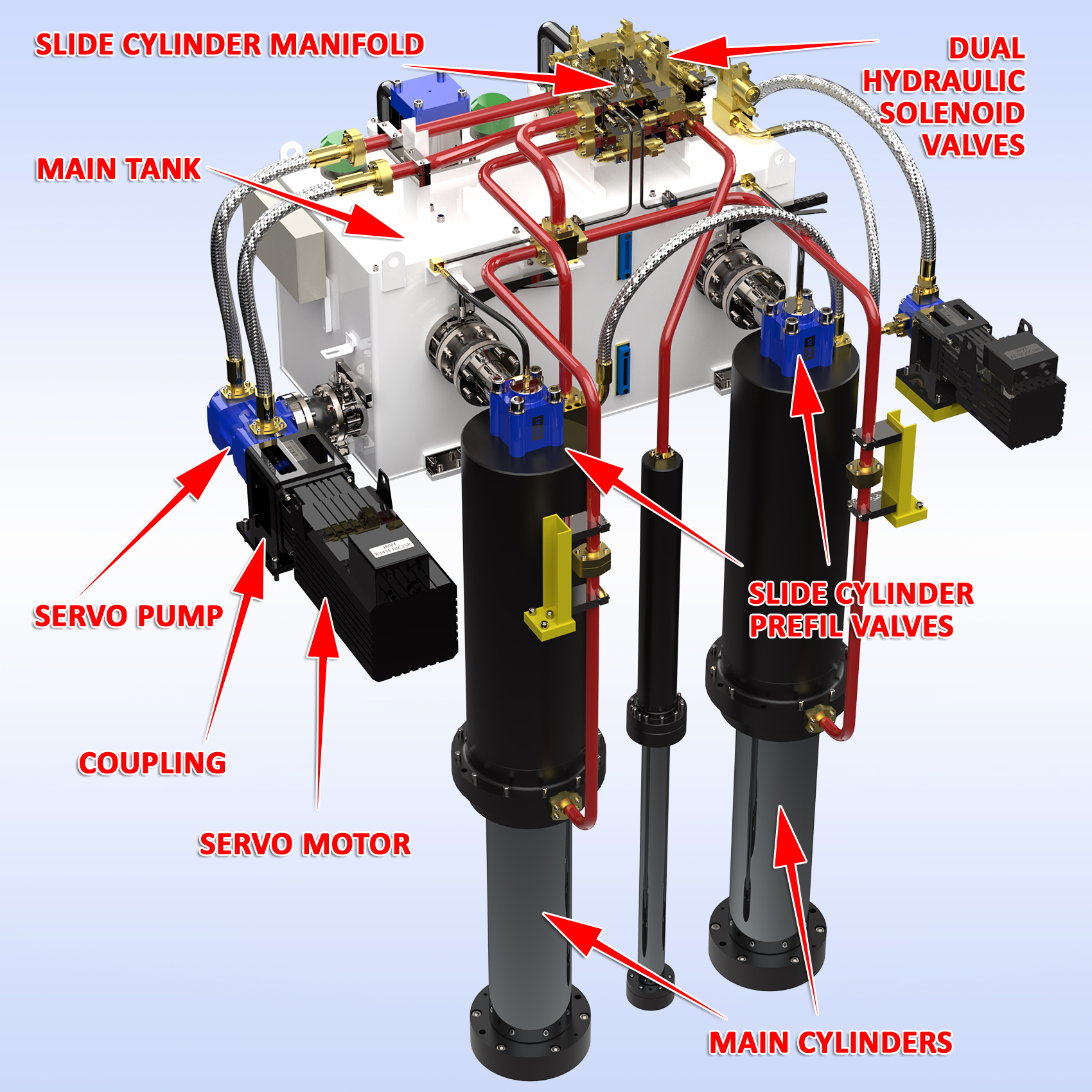
Hydraulic fluid management system with filtration and cooling on mechanical press
Hydraulic System  |  Reservoir, filters, pumps, and monitoring for press fluid management

What is the critical hydraulic fluid operating temperature range?

110°F to 140°F under normal production conditions. Temperature below this range signals cooling system failure or inadequate circulation. Temperature above this range accelerates fluid breakdown and seal hardening. Monitor with infrared thermometers or built-in sensors on every shift. Record trending data. A ten-degree drift upward over six weeks is the leading indicator of filter clogging or pump cavitation.

How often should hydraulic fluid be sampled and analyzed?

Quarterly at minimum for high-cycle presses, or per manufacturer specification. Fluid analysis monitors for wear metals, water content, contamination, and oxidation. The analysis costs less than the downtime of waiting for a seal to fail. A trending program lets you schedule fluid replacement before degradation becomes visible.

Why should reservoir breathers be replaced on schedule?

A dirty or failing breather allows moisture and dust into the reservoir. Moisture corrodes pump surfaces and hardens seals. Dust creates abrasive particles that score cylinders and vanes. Breathers are the cheapest component on the fluid system. Inspect monthly and replace at the first sign of contamination or saturation. Keep spare breathers in inventory.

What is the correct approach to topping off a hydraulic reservoir?

Use closed-system fluid transfer only. Never pour fluid into an open reservoir. Open-system transfers pull ambient air into the tank, introducing moisture and introducing oxidation pathways. Sealed fluid transfer maintains cleanliness and system integrity. This single practice prevents more hydraulic failures than every other maintenance step combined.
Fluid Health Indicator
Quarterly analysis trend → Stable metrics  |  Rising wear metals or water = drain and replace
System 09 of 11

I-PRESS Controls. The Future Built For Today.

I-PRESS is a control system engineered for mechanical, servo hydraulic, and forge presses, and a retrofit-ready upgrade for existing mechanical and forge presses. It brings Industry 4.0 architecture, remote monitoring, predictive maintenance, and real-time data collection to presses that were manufactured before the internet existed. A retrofit to I-PRESS does not change the mechanical behavior of the press. It changes visibility into the press, enabling data-driven decisions about maintenance intervals, setpoint optimization, and production capacity. For presses running on legacy electromechanical controls, the upgrade is not optional-it is a competitive advantage.
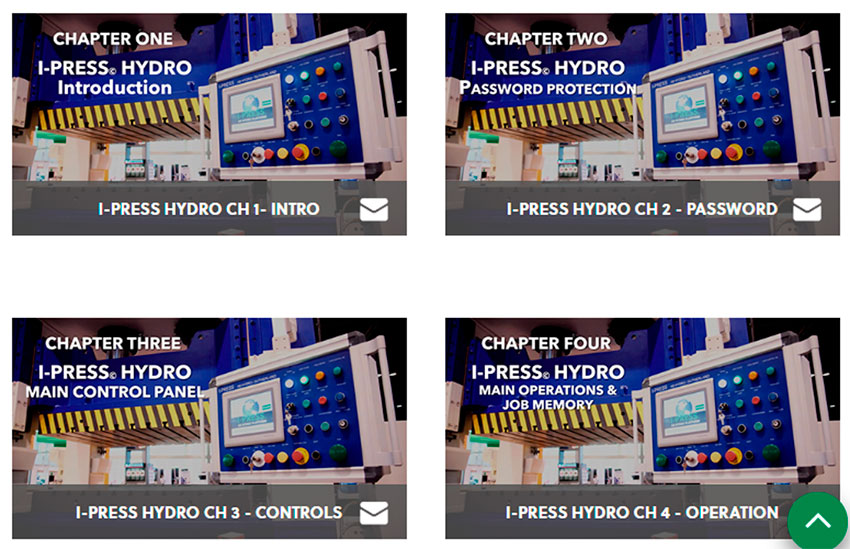
I-PRESS HYDRO control system interface for servo hydraulic press operation
I-PRESS HYDRO Control System  |  Servo-hydraulic control with real-time monitoring and data capture
Please Note
Retrofit upgrades apply to mechanical and forge presses. I-PRESS HYDRO is not available as a retrofit. It ships as the integrated control on servo-hydraulic presses.

What are the primary benefits of I-PRESS over legacy controls?

Remote monitoring and diagnostics, predictive maintenance alerts, automated setpoint logging, real-time production analytics, and seamless integration with plant systems. I-PRESS captures every cycle event-tonnage, position, timing, fault codes-and surfaces trends that legacy controls hide. A bearing starting to fail becomes visible in the data three weeks before the operator hears noise.

Is I-PRESS compatible with existing sensors and actuators?

Yes. I-PRESS integrates seamlessly with legacy hardware. The retrofit does not require replacement of air lines, hydraulic hoses, or mechanical components. Sensors and limit switches remain unchanged. The upgrade is to the control brain, not to the mechanical body of the press.

What are the safety certifications for I-PRESS?

I-PRESS achieves Category 3 and Performance Level D (PL-D) safety certifications, the highest compliance standards for operator protection. Built-in safety circuitry, interlocks, and diagnostic algorithms exceed OSHA requirements and satisfy customer audit standards for safety-critical applications.

Can I-PRESS be scaled across multiple presses?

Yes. Modular architecture allows retrofit of a single press or roll-out across an entire plant. Data is centralized and dashboards are shared, enabling press-by-press comparisons and fleet-wide trend analysis. The cost of the first upgrade is higher. The second and third are significantly lower due to shared infrastructure and team learning.
Industry 4.0 Readiness
I-PRESS retrofit → Real-time data, remote access, predictive alerts
Ready for the Next Generation?
See I-PRESS in action. No commitment required.
View I-PRESS Demo
System 10 of 11

Lubrication Systems. Friction Is The Enemy.

Grease-based and automatic oil systems serve different purposes on different presses. Grease handles high-load intermittent use. Oil handles high-speed continuous operation. Both require verification that lubrication is actually reaching the bearing surface. A failed grease line or a blocked oil port looks like a functioning system right up until the bearing seizes. The difference between a bearing that runs for five years and one that fails in five months is often just the presence or absence of a weekly flow verification.
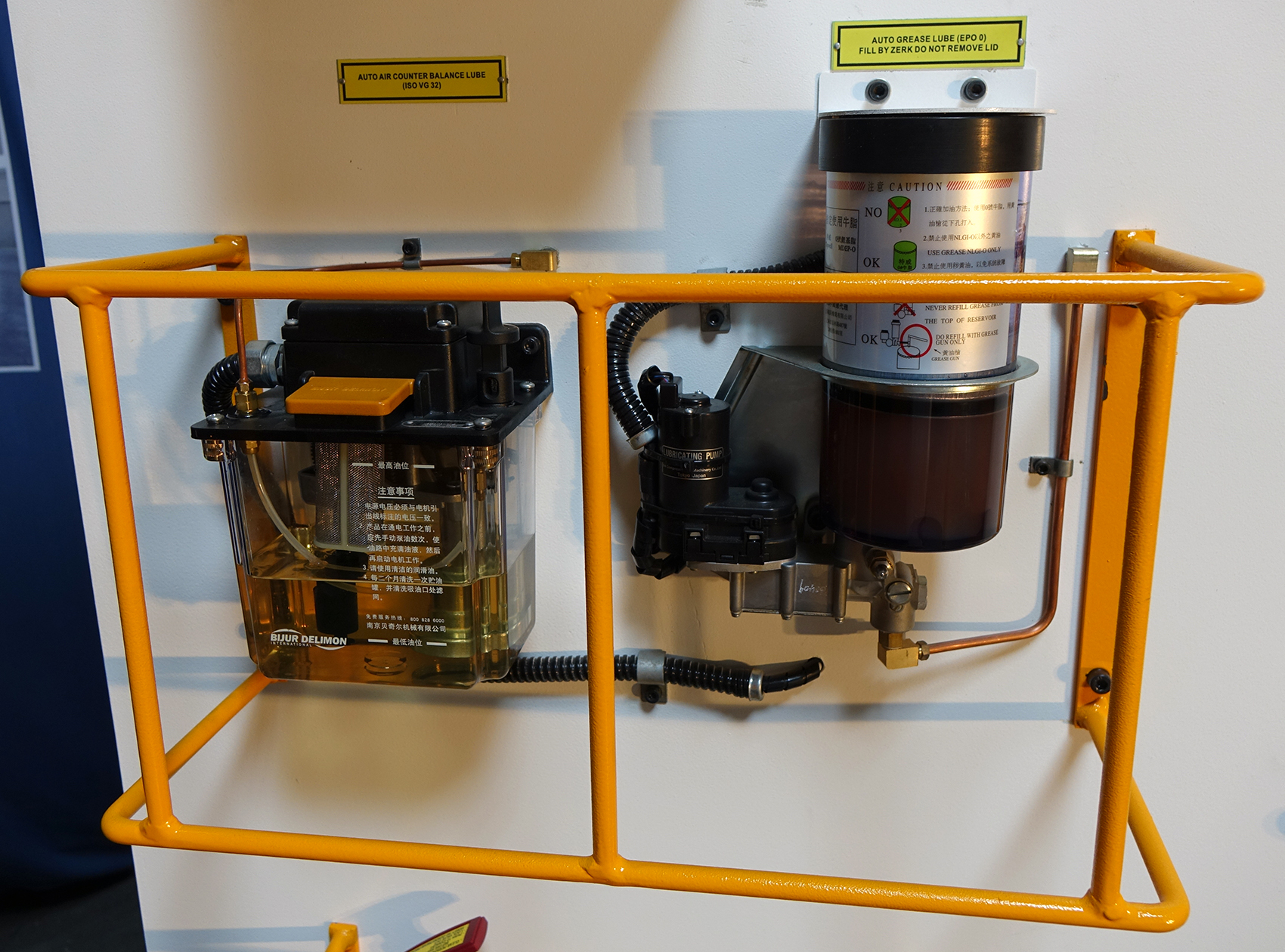
Automatic grease lubrication system with distribution blocks and delivery lines for mechanical press
Grease Lubrication System  |  Automatic distribution with metering and manifold blocks

Should lubrication intervals be based on time or stroke count?

Always stroke count. A press running at 10 strokes per minute is not the same as a press running at 40 strokes per minute. If the controller is set to lubricate every 3000 strokes, that translates to every five hours at 10 SPM but every 75 minutes at 40 SPM. Verify the interval is appropriate by monitoring bearing temperature and grease cleanliness. Excess grease is wasteful. Too little causes rapid wear.

What is the difference between grease and oil lubrication systems?

Grease systems are designed for high-load intermittent use where oil might leak away. Oil systems provide continuous circulation for high-speed operations requiring consistent heat dissipation and film coverage. Both types require visual verification that lubrication is actually reaching delivery points. If a grease line blocks, the press still runs-until the bearing seizes. That is the silent failure.

How is oil circulation verified in an automatic oil system?

Use flow meters or electronic indicators installed on the outlet side of the pump. Watch for flow on every shift. Compare readings to baseline. A sudden drop in flow signals filter clogging or pump cavitation. Modern systems include low-flow alarms. Verify these are enabled and tested on every startup. A plugged filter is not a maintenance problem-it is a visibility problem.

When should grease and oil be replaced?

Grease: Replace every six months if the system runs continuously, or annually if intermittent. Check contamination-if grease shows discoloration or metal particles, replace immediately. Oil: Per manufacturer specification or quarterly, whichever comes first. Store spare lubricants in sealed containers away from moisture and heat. Do not mix types.
Lubrication Verification
Flow monitoring → Daily visual check, logged  |  No flow = stop press immediately
System 11 of 11

PMP Program. Scheduled Prevention Beats Emergency Repair.

A preventative maintenance program is not a checklist. It is a documentation system that forces consistency, creates a paper trail, and generates trending data. The Sutherland PMP uses Red-Yellow-Green coding to prioritize findings and photographs to document every item. A technician walks the floor, documents the condition of all eleven systems, rates each item, and you get a prioritized action list with photographs. No guessing. No surprises six months later.

The program started with one customer in 2018. That customer ran 107 million press strokes over five years without an unplanned downtime event. That is not luck. That is the result of documented, scheduled, photographed maintenance discipline.
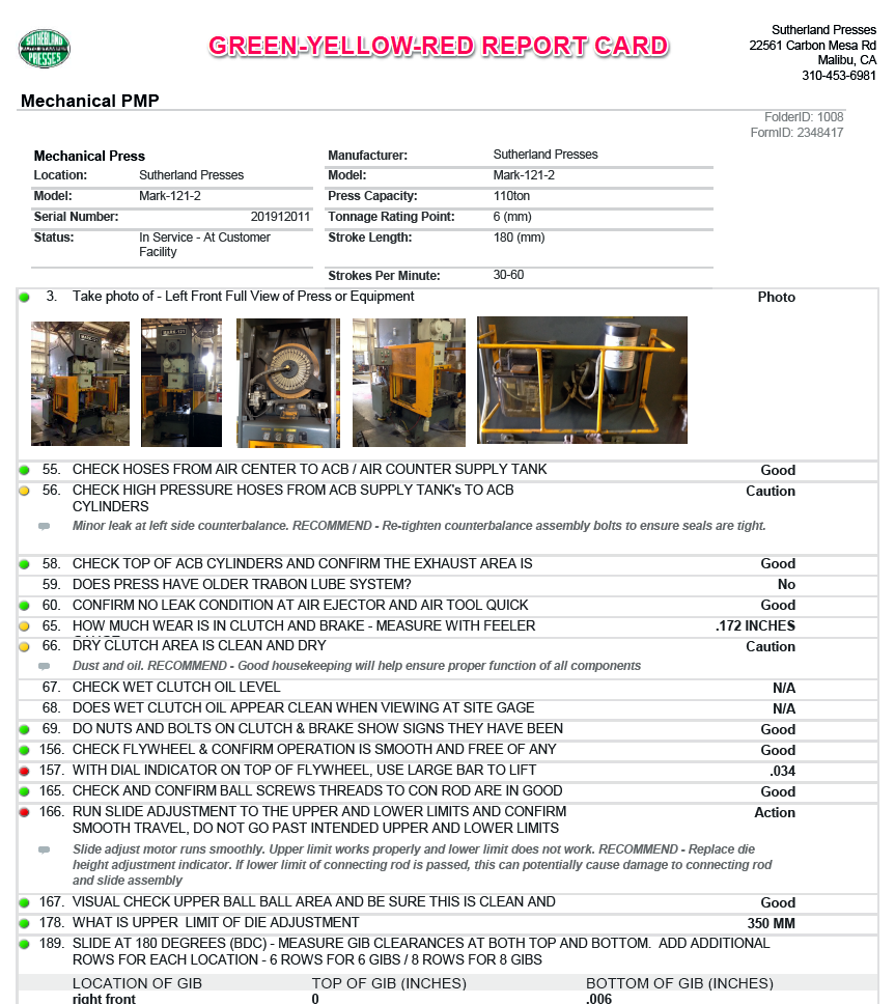
PMP preventative maintenance report card with Red Yellow Green status indicators and photo documentation
PMP Report Card  |  Red-Yellow-Green system with photo-backed findings for every system

What does the Red-Yellow-Green rating system mean?

Red: Immediate action required-critical wear, major leaks, safety hazards. Yellow: Monitor and plan-early warning signs, trending degradation, scheduled replacement due soon. Green: Functioning as designed-no immediate action required. Every rating is backed by photographs and technician notes, creating an audit trail that satisfies customer quality requirements and insurance inspections.

How often should a PMP inspection be scheduled?

Quarterly is the baseline for most operations. High-cycle presses with aggressive production schedules may benefit from monthly inspections. Low-cycle presses can extend to bi-annual. The inspection interval should match your risk tolerance and the historical failure rate of the press. Use PMP findings to adjust the interval-if every inspection finds Yellow items, increase frequency.

What should a maintenance log record?

Date, technician name, system inspected, condition rating, findings, photographs, and recommended action. If corrective maintenance was performed, note the corrective action and the date completed. This log becomes the system's service history. It demonstrates due diligence in the event of a production or safety issue. It also identifies patterns-if the same system repeatedly generates Yellow flags, the press may need a more fundamental upgrade or replacement.

What is the ROI of a preventative maintenance program?

Dramatic. The most conservative estimate: catching a hydraulic leak before the system fails saves forty hours of emergency service. Identifying gib drift before a die fails saves the cost of a new die. Preventing an unplanned shutdown protects delivery commitments and customer relationships. The PMP costs money. The absence of PMP costs more.
PMP Documentation Standard
Every finding photographed, rated Red-Yellow-Green, and tracked over time → Predictable maintenance spend
Why It Matters

What Lifecycle Management Buys You. In Hard Numbers.

01

Extended Equipment Life

Hydraulic fluid cleanliness and lubrication discipline add years to press life. A five-year press becomes seven years. A seven-year press becomes ten.

02

Predictable Downtime

PMP findings let you schedule replacement of wear components during planned maintenance windows, not in the middle of production. Control the calendar instead of the calendar controlling you.

03

Lower Lifecycle Cost

A hydraulic fluid analysis costs one hundred dollars and prevents a twenty-thousand-dollar pump failure. PMP discipline is the highest-ROI maintenance investment you can make.

04

Operator Confidence

Documented maintenance and I-PRESS data let operators understand the condition of their press. Confidence translates to faster production cycles and fewer hesitations on long runs.

05

Customer Compliance

Automotive and tier-one manufacturers require PMP documentation and traceability. Without it, your press is ineligible for high-value contracts. With it, the press becomes an asset.

06

Future-Proof Architecture

I-PRESS retrofit and PMP data create the foundation for AI-driven predictive maintenance and autonomous fleet management. The presses you maintain today power the operations of tomorrow.

Key Takeaways

Hydraulic fluid cleanliness is the cheapest insurance on the press. Lubrication flow verification is the fastest way to catch bearing failure before it happens. I-PRESS transforms a mechanical machine into a data source and enables decisions based on trends, not hunches. PMP discipline-scheduled, documented, photographed-is the difference between managing maintenance and reacting to emergencies. The systems are designed. The practices are proven. The decision is yours.

Three-Part Series Complete

Keep Your Press Running. Your Way.

Sutherland Presses publishes this eleven-system maintenance framework not to sell service agreements, but because press reliability is the foundation of manufacturing excellence. If you operate a press-whether it was built by Sutherland or by another OEM-these systems apply. The discipline applies. The ROI applies.

For questions about any of the systems covered in this three-part series, or to schedule a PMP inspection, our engineering team is available.

Same Business Day Response

< BACK TO SUTHERLAND NEWS

Sutherland Presses

HYDRAULICS, LUBRICATION, I-PRESS, PMP: THE LIFECYCLE SYSTEMS OF EVERY MECHANICAL PRESS

Sutherland Presses logo
Maintenance Reference | For Engineers and Maintenance Teams

Hydraulics, Lubrication, I-PRESS, & PMP.
The Lifecycle Systems That Protect Your Investment.

Foundation. Precision. Lifecycle. The three pillars of mechanical press reliability. The first two are about what happens in the stroke-air pressure, clutch engagement, slide alignment, load protection. The third is about what happens between strokes. Hydraulic fluid quality. Lubrication delivery. Control system upgrades. Scheduled inspections. These systems do not govern the press operation. They govern how long the press stays in operation. Neglect any one and the clock on equipment life accelerates.

The systems covered in this final reference are hydraulic fluid management, automated lubrication, I-PRESS control retrofits, and preventative maintenance programs. They are Systems 08, 09, 10, and 11 of the eleven-system maintenance framework. This reference concludes the three-part series published by Sutherland Presses. The full eleven-system guide is available on the Press Maintenance Tips page.

110°F–140°F
Optimal Operating RangeHydraulic Fluid Temperature
3000strokes
Lubrication IntervalVerify Adequacy by Wear Monitoring
107million
Documented UptimeFortune 100 Customer with PMP Discipline
System 08 of 11

Hydraulic Fluid Management. The Invisible Killer.

Hydraulic fluid is not gasoline. It is not motor oil. It is a precision lubricant engineered to flow through tight clearances, dampen shock loads, and maintain film strength across a range of pressures and temperatures. Water breaks down the film. Dirt accelerates wear. Heat hardens the seals. A fluid analysis costs one hundred dollars and catches all three problems before they become a twenty-thousand-dollar repair. Properly maintained hydraulic fluid is the cheapest insurance a press owner can buy.

Hydraulic fluid management system with filtration and cooling on mechanical press
Hydraulic System  |  Reservoir, filters, pumps, and monitoring for press fluid management

What is the critical hydraulic fluid operating temperature range?

110°F to 140°F under normal production conditions. Temperature below this range signals cooling system failure or inadequate circulation. Temperature above this range accelerates fluid breakdown and seal hardening. Monitor with infrared thermometers or built-in sensors on every shift. Record trending data. A ten-degree drift upward over six weeks is the leading indicator of filter clogging or pump cavitation.

How often should hydraulic fluid be sampled and analyzed?

Quarterly at minimum for high-cycle presses, or per manufacturer specification. Fluid analysis monitors for wear metals, water content, contamination, and oxidation. The analysis costs less than the downtime of waiting for a seal to fail. A trending program lets you schedule fluid replacement before degradation becomes visible.

Why should reservoir breathers be replaced on schedule?

A dirty or failing breather allows moisture and dust into the reservoir. Moisture corrodes pump surfaces and hardens seals. Dust creates abrasive particles that score cylinders and vanes. Breathers are the cheapest component on the fluid system. Inspect monthly and replace at the first sign of contamination or saturation. Keep spare breathers in inventory.

What is the correct approach to topping off a hydraulic reservoir?

Use closed-system fluid transfer only. Never pour fluid into an open reservoir. Open-system transfers pull ambient air into the tank, introducing moisture and introducing oxidation pathways. Sealed fluid transfer maintains cleanliness and system integrity. This single practice prevents more hydraulic failures than every other maintenance step combined.
Fluid Health Indicator
Quarterly analysis trend → Stable metrics  |  Rising wear metals or water = drain and replace
System 09 of 11

I-PRESS Controls. The Future Built For Today.

I-PRESS is a control system engineered for mechanical, servo hydraulic, and forge presses, and a retrofit-ready upgrade for existing mechanical and forge presses. It brings Industry 4.0 architecture, remote monitoring, predictive maintenance, and real-time data collection to presses that were manufactured before the internet existed. A retrofit to I-PRESS does not change the mechanical behavior of the press. It changes visibility into the press, enabling data-driven decisions about maintenance intervals, setpoint optimization, and production capacity. For presses running on legacy electromechanical controls, the upgrade is not optional-it is a competitive advantage.

I-PRESS HYDRO control system interface for servo hydraulic press operation
I-PRESS HYDRO Control System  |  Servo-hydraulic control with real-time monitoring and data capture
Please Note
Retrofit upgrades apply to mechanical and forge presses. I-PRESS HYDRO is not available as a retrofit. It ships as the integrated control on servo-hydraulic presses.

What are the primary benefits of I-PRESS over legacy controls?

Remote monitoring and diagnostics, predictive maintenance alerts, automated setpoint logging, real-time production analytics, and seamless integration with plant systems. I-PRESS captures every cycle event-tonnage, position, timing, fault codes-and surfaces trends that legacy controls hide. A bearing starting to fail becomes visible in the data three weeks before the operator hears noise.

Is I-PRESS compatible with existing sensors and actuators?

Yes. I-PRESS integrates seamlessly with legacy hardware. The retrofit does not require replacement of air lines, hydraulic hoses, or mechanical components. Sensors and limit switches remain unchanged. The upgrade is to the control brain, not to the mechanical body of the press.

What are the safety certifications for I-PRESS?

I-PRESS achieves Category 3 and Performance Level D (PL-D) safety certifications, the highest compliance standards for operator protection. Built-in safety circuitry, interlocks, and diagnostic algorithms exceed OSHA requirements and satisfy customer audit standards for safety-critical applications.

Can I-PRESS be scaled across multiple presses?

Yes. Modular architecture allows retrofit of a single press or roll-out across an entire plant. Data is centralized and dashboards are shared, enabling press-by-press comparisons and fleet-wide trend analysis. The cost of the first upgrade is higher. The second and third are significantly lower due to shared infrastructure and team learning.
Industry 4.0 Readiness
I-PRESS retrofit → Real-time data, remote access, predictive alerts
Ready for the Next Generation?
See I-PRESS in action. No commitment required.
View I-PRESS Demo
System 10 of 11

Lubrication Systems. Friction Is The Enemy.

Grease-based and automatic oil systems serve different purposes on different presses. Grease handles high-load intermittent use. Oil handles high-speed continuous operation. Both require verification that lubrication is actually reaching the bearing surface. A failed grease line or a blocked oil port looks like a functioning system right up until the bearing seizes. The difference between a bearing that runs for five years and one that fails in five months is often just the presence or absence of a weekly flow verification.

Automatic grease lubrication system with distribution blocks and delivery lines for mechanical press
Grease Lubrication System  |  Automatic distribution with metering and manifold blocks

Should lubrication intervals be based on time or stroke count?

Always stroke count. A press running at 10 strokes per minute is not the same as a press running at 40 strokes per minute. If the controller is set to lubricate every 3000 strokes, that translates to every five hours at 10 SPM but every 75 minutes at 40 SPM. Verify the interval is appropriate by monitoring bearing temperature and grease cleanliness. Excess grease is wasteful. Too little causes rapid wear.

What is the difference between grease and oil lubrication systems?

Grease systems are designed for high-load intermittent use where oil might leak away. Oil systems provide continuous circulation for high-speed operations requiring consistent heat dissipation and film coverage. Both types require visual verification that lubrication is actually reaching delivery points. If a grease line blocks, the press still runs-until the bearing seizes. That is the silent failure.

How is oil circulation verified in an automatic oil system?

Use flow meters or electronic indicators installed on the outlet side of the pump. Watch for flow on every shift. Compare readings to baseline. A sudden drop in flow signals filter clogging or pump cavitation. Modern systems include low-flow alarms. Verify these are enabled and tested on every startup. A plugged filter is not a maintenance problem-it is a visibility problem.

When should grease and oil be replaced?

Grease: Replace every six months if the system runs continuously, or annually if intermittent. Check contamination-if grease shows discoloration or metal particles, replace immediately. Oil: Per manufacturer specification or quarterly, whichever comes first. Store spare lubricants in sealed containers away from moisture and heat. Do not mix types.
Lubrication Verification
Flow monitoring → Daily visual check, logged  |  No flow = stop press immediately
System 11 of 11

PMP Program. Scheduled Prevention Beats Emergency Repair.

A preventative maintenance program is not a checklist. It is a documentation system that forces consistency, creates a paper trail, and generates trending data. The Sutherland PMP uses Red-Yellow-Green coding to prioritize findings and photographs to document every item. A technician walks the floor, documents the condition of all eleven systems, rates each item, and you get a prioritized action list with photographs. No guessing. No surprises six months later.

The program started with one customer in 2018. That customer ran 107 million press strokes over five years without an unplanned downtime event. That is not luck. That is the result of documented, scheduled, photographed maintenance discipline.

PMP preventative maintenance report card with Red Yellow Green status indicators and photo documentation
PMP Report Card  |  Red-Yellow-Green system with photo-backed findings for every system

What does the Red-Yellow-Green rating system mean?

Red: Immediate action required-critical wear, major leaks, safety hazards. Yellow: Monitor and plan-early warning signs, trending degradation, scheduled replacement due soon. Green: Functioning as designed-no immediate action required. Every rating is backed by photographs and technician notes, creating an audit trail that satisfies customer quality requirements and insurance inspections.

How often should a PMP inspection be scheduled?

Quarterly is the baseline for most operations. High-cycle presses with aggressive production schedules may benefit from monthly inspections. Low-cycle presses can extend to bi-annual. The inspection interval should match your risk tolerance and the historical failure rate of the press. Use PMP findings to adjust the interval-if every inspection finds Yellow items, increase frequency.

What should a maintenance log record?

Date, technician name, system inspected, condition rating, findings, photographs, and recommended action. If corrective maintenance was performed, note the corrective action and the date completed. This log becomes the system's service history. It demonstrates due diligence in the event of a production or safety issue. It also identifies patterns-if the same system repeatedly generates Yellow flags, the press may need a more fundamental upgrade or replacement.

What is the ROI of a preventative maintenance program?

Dramatic. The most conservative estimate: catching a hydraulic leak before the system fails saves forty hours of emergency service. Identifying gib drift before a die fails saves the cost of a new die. Preventing an unplanned shutdown protects delivery commitments and customer relationships. The PMP costs money. The absence of PMP costs more.
PMP Documentation Standard
Every finding photographed, rated Red-Yellow-Green, and tracked over time → Predictable maintenance spend
Why It Matters

What Lifecycle Management Buys You. In Hard Numbers.

01

Extended Equipment Life

Hydraulic fluid cleanliness and lubrication discipline add years to press life. A five-year press becomes seven years. A seven-year press becomes ten.

02

Predictable Downtime

PMP findings let you schedule replacement of wear components during planned maintenance windows, not in the middle of production. Control the calendar instead of the calendar controlling you.

03

Lower Lifecycle Cost

A hydraulic fluid analysis costs one hundred dollars and prevents a twenty-thousand-dollar pump failure. PMP discipline is the highest-ROI maintenance investment you can make.

04

Operator Confidence

Documented maintenance and I-PRESS data let operators understand the condition of their press. Confidence translates to faster production cycles and fewer hesitations on long runs.

05

Customer Compliance

Automotive and tier-one manufacturers require PMP documentation and traceability. Without it, your press is ineligible for high-value contracts. With it, the press becomes an asset.

06

Future-Proof Architecture

I-PRESS retrofit and PMP data create the foundation for AI-driven predictive maintenance and autonomous fleet management. The presses you maintain today power the operations of tomorrow.

Key Takeaways

Hydraulic fluid cleanliness is the cheapest insurance on the press. Lubrication flow verification is the fastest way to catch bearing failure before it happens. I-PRESS transforms a mechanical machine into a data source and enables decisions based on trends, not hunches. PMP discipline-scheduled, documented, photographed-is the difference between managing maintenance and reacting to emergencies. The systems are designed. The practices are proven. The decision is yours.

Three-Part Series Complete

Keep Your Press Running. Your Way.

Sutherland Presses publishes this eleven-system maintenance framework not to sell service agreements, but because press reliability is the foundation of manufacturing excellence. If you operate a press-whether it was built by Sutherland or by another OEM-these systems apply. The discipline applies. The ROI applies.

For questions about any of the systems covered in this three-part series, or to schedule a PMP inspection, our engineering team is available.

Same Business Day Response

Heading

Heading

Lorem ipsum dolor sit amet, consectetur adipiscing elit. Suspendisse varius enim in eros elementum tristique. Duis cursus, mi quis viverra ornare, eros dolor interdum nulla, ut commodo diam libero vitae erat. Aenean faucibus nibh et justo cursus id rutrum lorem imperdiet. Nunc ut sem vitae risus tristique posuere.

back to news >

SUTHERLAND CLIENTS

REQUEST A QUOTE