
01
Complete Line, Coil to Part
Blanking, tandem transfer, progressive die cells, automation, and inspection in one engineered system, not just a press.

Underneath the chips and the power, the AI data center boom is a steel problem. The U.S. is scheduled to bring 36 GW of new data center capacity online in 2027 alone, more than 2024, 2025, and 2026 combined, and every gigawatt is hundreds of thousands of formed steel parts. This is the DC-SL stamping line Sutherland and KC Presses built to form racks, enclosures, and cabinets from coil to inspected part.
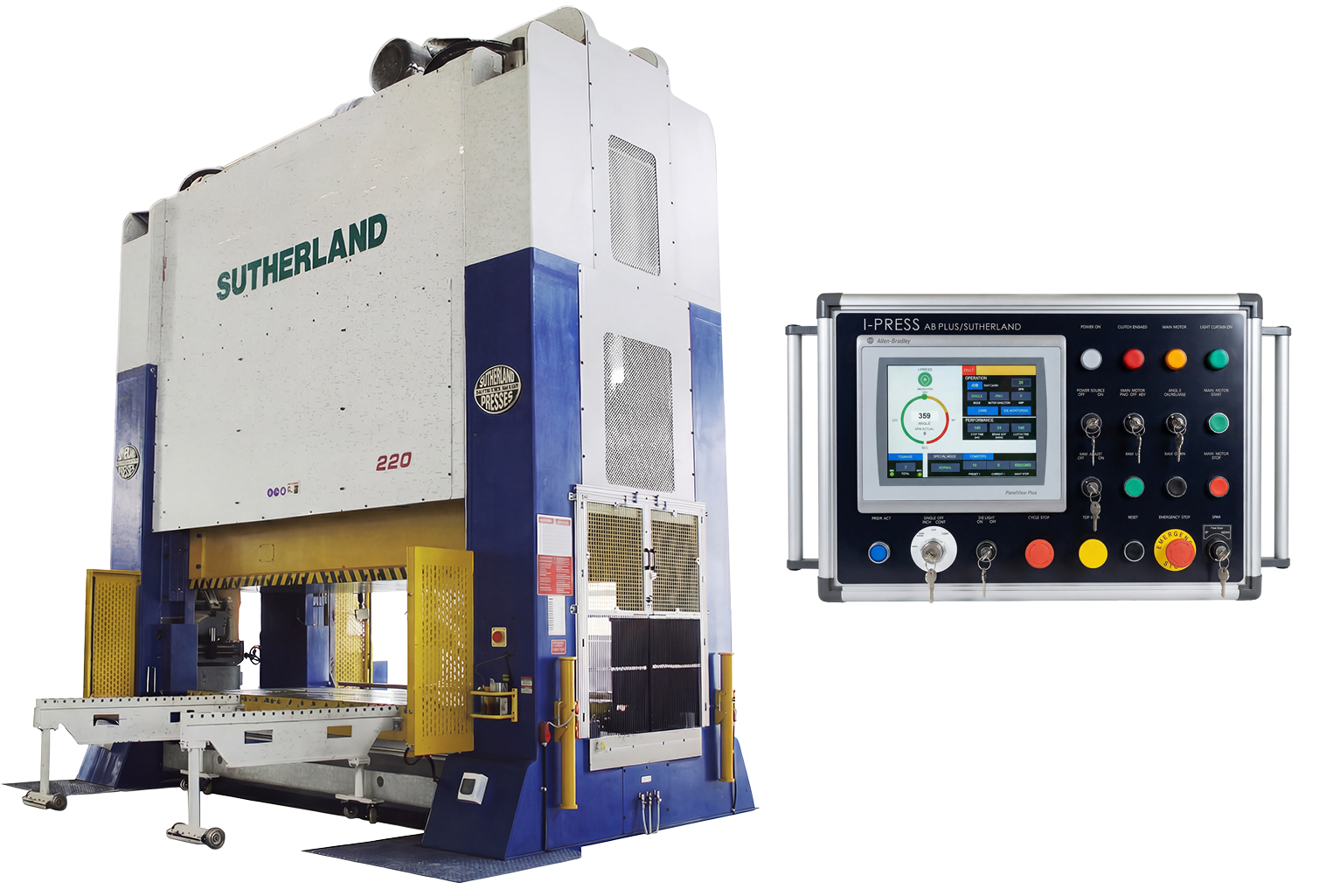
Behind every data center is metal. Server racks, electrical enclosures, cooling cabinets, cable management, and support structures, almost all of it is sheet metal, and almost all of that sheet metal is formed on a press. When the industry adds tens of gigawatts of capacity in a single year, it is also stamping millions of rack and enclosure parts. That demand lands on the manufacturers who build them, and every capacity move they make is a press decision.
Sutherland and KC Presses build the complete line that forms those parts. The DC-SL system, short for Data Center Stamping Line, is a dedicated stamping facility engineered to produce the full range of sheet metal components a data center needs: rack side panels, front and rear doors, roof panels, base frames, mounting rails, cable management components, power distribution enclosure parts, brackets, hinges, reinforcements, and small stamped hardware. Not a single press. The line that builds the cabinet, from coil to finished, inspected part.
Artificial intelligence has set off the largest data center buildout in history, and it is still accelerating. U.S. data center power demand is forecast to roughly double between 2025 and 2027 (Goldman Sachs). More than 50 GW was operating in the U.S. at the end of 2025 (FERC). The largest operators are spending roughly $750 billion on data centers this year (BloombergNEF), and global capacity is on track to roughly double to about 200 GW by 2030 (JLL). The buildings are getting bigger, too, the average data center has grown from 25 MW in 2020 to nearly 80 MW, which means more steel in every one.
If you build racks, enclosures, or cabinets, you are being asked to scale for this almost overnight. Designs change generation to generation. The same floor has to run a custom enclosure today and a hyperscale commodity tomorrow. Every die change that drags into an hour is a shift you do not get back. And the press you buy now is a decision you live with for the next decade. That is the squeeze, and it is exactly what the DC-SL line is built to take off your floor.
The DC-SL line is offered on three press platforms. They differ in the drive, which decides speed, flexibility, and cost per part. The right one depends on what you form, how many, and how often the design changes, and Sutherland builds all three on one I-PRESS control platform.
Full tonnage at any point in the stroke, programmable slide motion, and deep-draw capability. Tandem 400–1500 tons, changeover under 10 minutes. Built for custom and high-mix enclosure work and frequent design changes.
A proven flywheel-driven mechanical drive for the highest throughput and lowest capital cost. Tandem 400–2000 tons, 15–35 SPM. Built for hyperscale commodity production at volume.
Mechanical speed and stiffness with programmable servo motion, energy recovery, and longer die life. Tandem 400–1000 tons, changeover 3–8 minutes. Built for high mix and high volume together.
| Specification | DC-SL FLEX Servo Hydraulic | DC-SL PRODUCTION Mechanical | DC-SL ADVANCED Servo Mechanical |
|---|---|---|---|
| Best for | Custom, high-mix, frequent changes | Hyperscale, highest volume | High mix and high volume together |
| Tandem presses | 8 × 400–1500 tons | 8 × 400–2000 tons | 8 × 400–1000 tons |
| Speed | 5–20 SPM, programmable | 15–35 SPM | 10–30 SPM, programmable |
| Slide motion | Fully programmable | Fixed by drive | Fully programmable |
| Die changeover | Under 10 minutes | 5 to 10 minutes | 3 to 8 minutes |
| Cost position | Most cost-effective to start | Lowest cost per part at volume | Highest cost, best overall |
"We do not just sell a press. We build the line that builds your cabinet, from coil to inspected part, on the platform your volume calls for. When a fabricator scales for this boom, that is the partner they need."
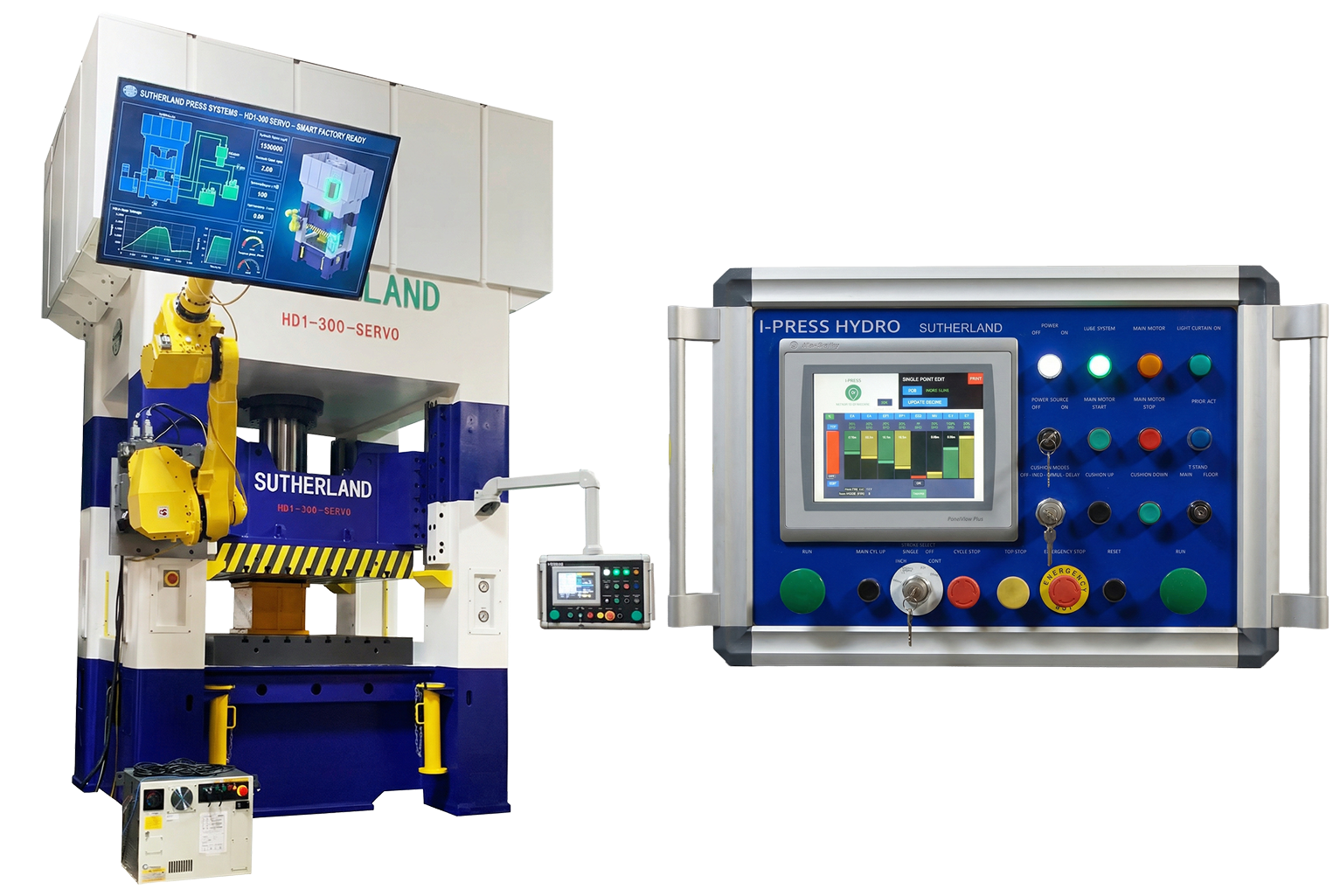
Every press in the DC-SL line runs twin rolling bolsters, with offline die setup staged to the left and right of the active position. Die changes happen in under ten minutes instead of hours. For a fabricator running many cabinet designs, that is the difference between one line and three, and it is how a single DC-SL line keeps pace with a product mix that changes generation to generation.

The DC-SL line is built on the same proven tandem-line engineering Sutherland already runs in high-volume production plants, configured for racks and enclosures instead of appliances. Coil-fed blanking, an eight-press automated tandem transfer line, parallel progressive die cells for brackets and cable management, robotic automation, and integrated vision inspection, engineered, built, and supported by one team, on one I-PRESS control platform, built past JIS First Class.
Most fabricators already have presses. The question is whether they change over fast enough for many cabinet designs. With twin rolling bolsters across the line, the DC-SL system changes dies in under ten minutes. If a die change is costing an hour today, that hour is exactly where the line pays for itself, run after run, shift after shift.
The same control platform running on stamping floors worldwide is open to explore right now. Navigate the screens, tonnage monitoring, multi-stage profiles, fault diagnostics, and the part recipe library. No login required. Before you buy a press, try the control.
Blanking, tandem transfer, progressive die cells, automation, and inspection in one engineered system, not just a press.
Twin rolling bolsters on every press let one line run many cabinet designs without losing a shift to die changes.
Servo hydraulic, mechanical, and servo mechanical, matched to your volume, mix, and cost-per-part target.
High-speed, repeatable, 24/7 production engineered to keep pace with hyperscale-rate output.
I-PRESS runs the whole line, with real-time monitoring and process data capture on every press.
Engineered and built to exceed JIS First Class, and supported by one team from quote to production.
Sutherland and KC Presses have engineered forming systems for high-volume production across North America, Mexico, Turkey, Vietnam, Taiwan, and China. The DC-SL line is designed and built in California and engineered to the tolerance, repeatability, and throughput benchmarks the data center supply chain now runs on.
From rack side panels and enclosure doors to base frames, mounting rails, power distribution cabinets, and cable management, our presses form the steel behind the buildout. Manufacturers do not choose them because of a spec sheet. They choose them because the line forms the part, changes over fast, and runs shift after shift without drifting.
And here is what we actually bring to the table: we do not hand you a press and wish you luck. We match the platform to the work you really run, build the line that forms it, automate it, and stand behind it with one team you can call by name, from the first quote to the millionth part. You are not buying a machine. You are getting a partner who owns the whole line, coil to inspected part.
If you are scaling for the data center boom on equipment that was never built for this pace, that is the conversation to have with us.
Talk to our team about the DC-SL stamping line, the three press platforms, and what it takes to form racks and enclosures from coil to inspected part at production volume.


Underneath the chips and the power, the AI data center boom is a steel problem. The U.S. is scheduled to bring 36 GW of new data center capacity online in 2027 alone, more than 2024, 2025, and 2026 combined, and every gigawatt is hundreds of thousands of formed steel parts. This is the DC-SL stamping line Sutherland and KC Presses built to form racks, enclosures, and cabinets from coil to inspected part.
Behind every data center is metal. Server racks, electrical enclosures, cooling cabinets, cable management, and support structures, almost all of it is sheet metal, and almost all of that sheet metal is formed on a press. When the industry adds tens of gigawatts of capacity in a single year, it is also stamping millions of rack and enclosure parts. That demand lands on the manufacturers who build them, and every capacity move they make is a press decision.
Sutherland and KC Presses build the complete line that forms those parts. The DC-SL system, short for Data Center Stamping Line, is a dedicated stamping facility engineered to produce the full range of sheet metal components a data center needs: rack side panels, front and rear doors, roof panels, base frames, mounting rails, cable management components, power distribution enclosure parts, brackets, hinges, reinforcements, and small stamped hardware. Not a single press. The line that builds the cabinet, from coil to finished, inspected part.
Artificial intelligence has set off the largest data center buildout in history, and it is still accelerating. U.S. data center power demand is forecast to roughly double between 2025 and 2027 (Goldman Sachs). More than 50 GW was operating in the U.S. at the end of 2025 (FERC). The largest operators are spending roughly $750 billion on data centers this year (BloombergNEF), and global capacity is on track to roughly double to about 200 GW by 2030 (JLL). The buildings are getting bigger, too, the average data center has grown from 25 MW in 2020 to nearly 80 MW, which means more steel in every one.
If you build racks, enclosures, or cabinets, you are being asked to scale for this almost overnight. Designs change generation to generation. The same floor has to run a custom enclosure today and a hyperscale commodity tomorrow. Every die change that drags into an hour is a shift you do not get back. And the press you buy now is a decision you live with for the next decade. That is the squeeze, and it is exactly what the DC-SL line is built to take off your floor.
The DC-SL line is offered on three press platforms. They differ in the drive, which decides speed, flexibility, and cost per part. The right one depends on what you form, how many, and how often the design changes, and Sutherland builds all three on one I-PRESS control platform.
Full tonnage at any point in the stroke, programmable slide motion, and deep-draw capability. Tandem 400–1500 tons, changeover under 10 minutes. Built for custom and high-mix enclosure work and frequent design changes.
A proven flywheel-driven mechanical drive for the highest throughput and lowest capital cost. Tandem 400–2000 tons, 15–35 SPM. Built for hyperscale commodity production at volume.
Mechanical speed and stiffness with programmable servo motion, energy recovery, and longer die life. Tandem 400–1000 tons, changeover 3–8 minutes. Built for high mix and high volume together.
| Specification | DC-SL FLEX Servo Hydraulic | DC-SL PRODUCTION Mechanical | DC-SL ADVANCED Servo Mechanical |
|---|---|---|---|
| Best for | Custom, high-mix, frequent changes | Hyperscale, highest volume | High mix and high volume together |
| Tandem presses | 8 × 400–1500 tons | 8 × 400–2000 tons | 8 × 400–1000 tons |
| Speed | 5–20 SPM, programmable | 15–35 SPM | 10–30 SPM, programmable |
| Slide motion | Fully programmable | Fixed by drive | Fully programmable |
| Die changeover | Under 10 minutes | 5 to 10 minutes | 3 to 8 minutes |
| Cost position | Most cost-effective to start | Lowest cost per part at volume | Highest cost, best overall |
"We do not just sell a press. We build the line that builds your cabinet, from coil to inspected part, on the platform your volume calls for. When a fabricator scales for this boom, that is the partner they need."
Every press in the DC-SL line runs twin rolling bolsters, with offline die setup staged to the left and right of the active position. Die changes happen in under ten minutes instead of hours. For a fabricator running many cabinet designs, that is the difference between one line and three, and it is how a single DC-SL line keeps pace with a product mix that changes generation to generation.
The DC-SL line is built on the same proven tandem-line engineering Sutherland already runs in high-volume production plants, configured for racks and enclosures instead of appliances. Coil-fed blanking, an eight-press automated tandem transfer line, parallel progressive die cells for brackets and cable management, robotic automation, and integrated vision inspection, engineered, built, and supported by one team, on one I-PRESS control platform, built past JIS First Class.
Most fabricators already have presses. The question is whether they change over fast enough for many cabinet designs. With twin rolling bolsters across the line, the DC-SL system changes dies in under ten minutes. If a die change is costing an hour today, that hour is exactly where the line pays for itself, run after run, shift after shift.
The same control platform running on stamping floors worldwide is open to explore right now. Navigate the screens, tonnage monitoring, multi-stage profiles, fault diagnostics, and the part recipe library. No login required. Before you buy a press, try the control.
Blanking, tandem transfer, progressive die cells, automation, and inspection in one engineered system, not just a press.
Twin rolling bolsters on every press let one line run many cabinet designs without losing a shift to die changes.
Servo hydraulic, mechanical, and servo mechanical, matched to your volume, mix, and cost-per-part target.
High-speed, repeatable, 24/7 production engineered to keep pace with hyperscale-rate output.
I-PRESS runs the whole line, with real-time monitoring and process data capture on every press.
Engineered and built to exceed JIS First Class, and supported by one team from quote to production.
Sutherland and KC Presses have engineered forming systems for high-volume production across North America, Mexico, Turkey, Vietnam, Taiwan, and China. The DC-SL line is designed and built in California and engineered to the tolerance, repeatability, and throughput benchmarks the data center supply chain now runs on.
From rack side panels and enclosure doors to base frames, mounting rails, power distribution cabinets, and cable management, our presses form the steel behind the buildout. Manufacturers do not choose them because of a spec sheet. They choose them because the line forms the part, changes over fast, and runs shift after shift without drifting.
And here is what we actually bring to the table: we do not hand you a press and wish you luck. We match the platform to the work you really run, build the line that forms it, automate it, and stand behind it with one team you can call by name, from the first quote to the millionth part. You are not buying a machine. You are getting a partner who owns the whole line, coil to inspected part.
If you are scaling for the data center boom on equipment that was never built for this pace, that is the conversation to have with us.
Talk to our team about the DC-SL stamping line, the three press platforms, and what it takes to form racks and enclosures from coil to inspected part at production volume.


