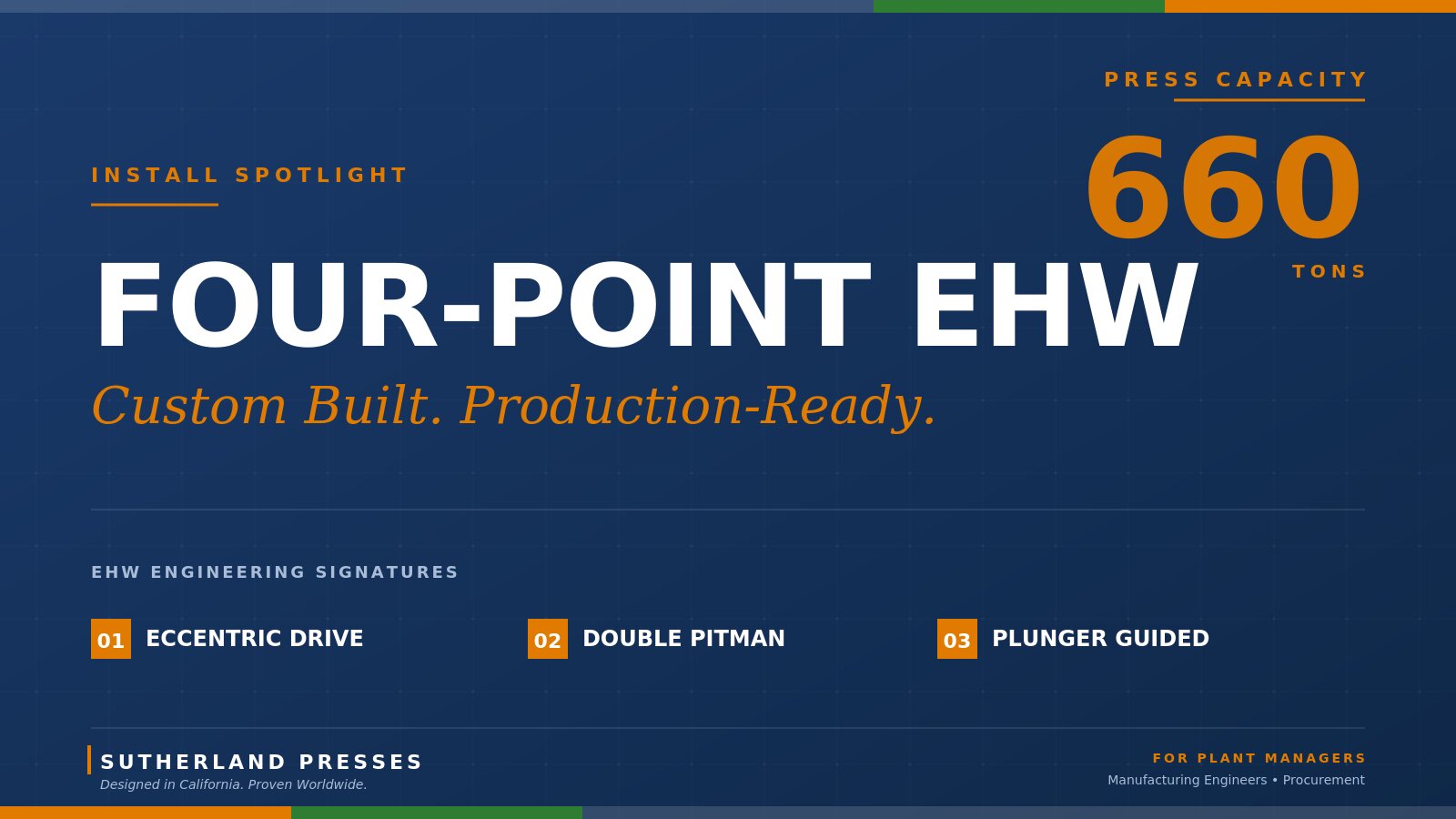
A 660-TON FOUR-POINT EHW INSTALL

Jun 6, 2026
Industry News
Sutherland Presses logo
Press Install Spotlight | For Manufacturing Engineers and Plant Managers

A 660-Ton Four-Point EHW.
Custom Built. Production-Ready.

When a heavy stamping application calls for tonnage, bed area, and side-thrust-free operation that standard configurations cannot deliver, the press has to be engineered around the application. The EHW-4-660-186-84 currently being installed is exactly that machine. Four-point eccentric drive. 660 tons of capacity. 186 inches of bed length. 84 inches of depth. Built for the heaviest production demands in automotive, recreational vehicle, appliance, and heavy-equipment manufacturing.

This article walks through the three things that matter on an install like this one: the press itself, the engineering approach that makes the four-point architecture work, and the I-PRESS controls platform that ships standard on every Sutherland mechanical press.
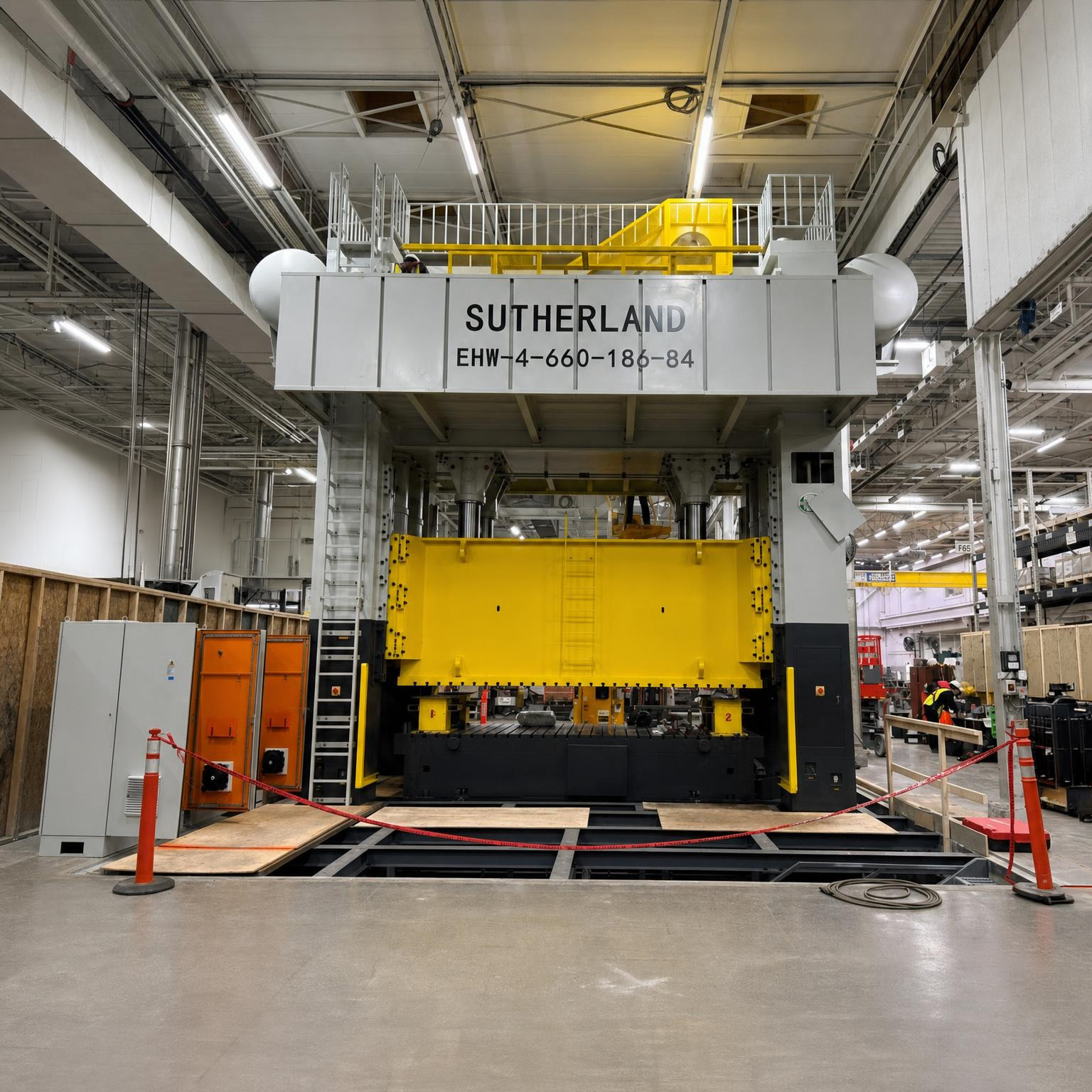
Sutherland EHW-4-660-186-84 four-point 660-ton eccentric heavy wide bed mechanical stamping press on the install floor
EHW-4-660-186-84  |  Front view on the Sutherland install floor. 660-ton, four-point eccentric, 186 by 84 inch bed.
660tons
Press CapacityFull Tonnage Rating
4points
Connection PointsEccentric Drive Architecture
186in. bed
Bed LengthBed Depth 84 Inches
Section 01 of 03

The Press. EHW Heavy Wide Bed.

EHW stands for Eccentric Heavy Wide bed. The series is Sutherland's most robust mechanical press platform, engineered for the heaviest stamping applications and the largest die areas. Standard EHW configurations run from 330 tons up to 2200 tons. The four-point variant is the premium architecture in the family, reserved for applications where bed length, off-center load tolerance, and slide rigidity all need to perform at the top of the specification at the same time. The press in these photos is one of those builds.
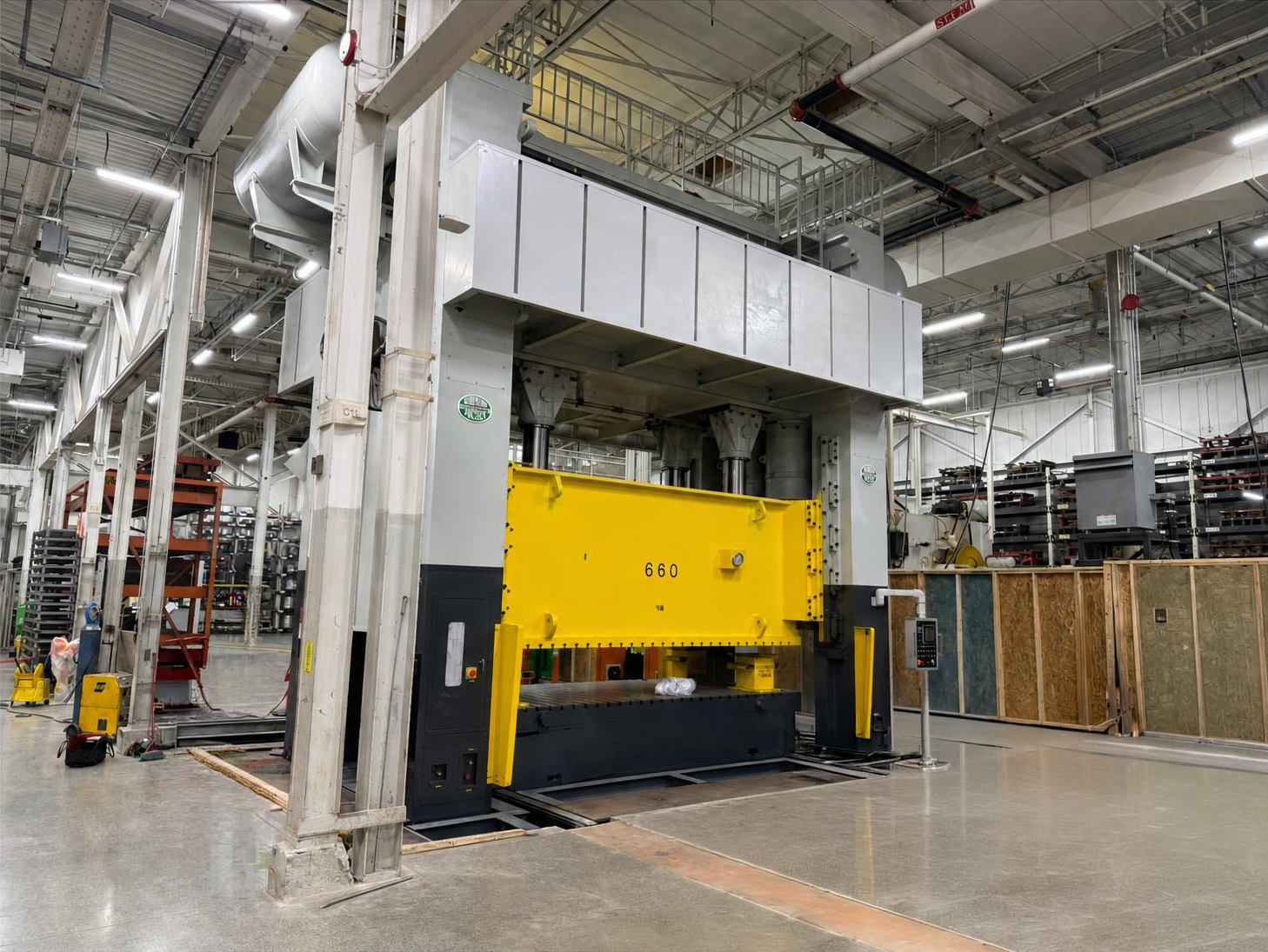
Side view of Sutherland EHW four-point 660-ton press showing crown housing, tie rods, and yellow slide with 660 ton designation
EHW Side Profile  |  Crown housing, four-post structure, and the 660-ton slide. Tie-rod construction for vibration-free heavy stamping.

What is a four-point eccentric press?

A four-point press transfers drive energy to the slide through four connection points rather than the standard one or two. The architecture distributes tonnage evenly across a wider slide, which controls off-center loading from large or asymmetric dies. On a 186-inch bed, the four-point configuration is what keeps the slide flat and the parallelism within tolerance even when the die loads the press unevenly. Two-point construction on a bed this wide would not hold parallelism on heavy off-center work.

What applications justify a custom 660-ton four-point EHW?

Heavy automotive structural stamping, recreational vehicle frame components, appliance pressings with large draw dies, and heavy-equipment body panels. Any application where the part is large, the die is heavy, and the production cycle has to repeat to tight tolerances for years without parallelism drift. The EHW is also a common spec for tandem-line lead positions where draw operations set the part envelope for everything that follows.

How does a custom EHW build differ from a standard catalogue press?

Bed dimensions, stroke, shut height, and SPM range are configured around the application. Tonnage rating is selected from the EHW range and matched to the largest expected die load with appropriate safety margin. Automation hooks, scrap handling, die clamping, and feeder integration are designed in from the foundation, not retrofitted later. The press leaves the Sutherland floor ready to integrate with the customer's existing line architecture.
EHW Series Range
330 to 2200 tons  |  Double or four-point configurations  |  Custom bed dimensions per application
Section 02 of 03

The Engineering. Plunger Guides That Don't Lie.

The thing that separates an EHW from a generic four-point press is the drive architecture. Sutherland's EHW uses a double pitman design with gears on the centerline driving vertical plunger guides. The plunger guides eliminate side thrust loads to the slide. That single design decision is what keeps parallelism inside specification across thousands of strokes, what protects die life, and what makes the four-point variant viable at the 186-inch bed width.

What is side thrust and why does it matter on a four-point press?

Side thrust is the lateral force imparted to the slide by the eccentric drive as it converts rotational energy into vertical motion. On a standard eccentric architecture, that side thrust transfers into the gibs as continuous lateral wear. On a 660-ton press running heavy production, that wear shortens gib life, accelerates parallelism drift, and shortens die life through misalignment. Plunger guides intercept the side thrust before it reaches the slide. Gibs no longer absorb the lateral force. Parallelism holds.

Why double pitman with centerline gears?

Two pitmans driving the slide from a centerline gear arrangement balance the drive load symmetrically on either side of the press. Single pitman designs concentrate load on one side and transfer the imbalance into the frame. Double pitman with centerline gears eliminates the imbalance at the drive stage, so the four-point gibs are guiding a slide that arrives at the bolster square, parallel, and on center. The four points then carry the production tonnage cleanly.

What does this architecture mean for die life and changeover?

A slide that stays parallel inside 0.001 inch across the full bed protects every die in the rack. Reverse tonnage stays controlled. Gib clearances stay within specification. Setup operators stop chasing alignment problems that originate upstream of the die. Die changeover gets faster because every die seats true to a known-square slide. Tooling life extends because the press is not silently grinding down die guide pins and bushings between shifts.
EHW Engineering Signature
Double pitman drive → Centerline gears → Vertical plunger guides → Zero side thrust to slide
Walk Through an EHW Build
Tour the EHW press platform. 360-degree configurator.
Launch the EHW Tour
Section 03 of 03

The Controls. I-PRESS Standard. Day One.

Every Sutherland mechanical press ships with I-PRESS controls as standard, including this 660-ton four-point EHW. The same architecture that runs on a 220-ton SP2 mechanical press runs on a 2200-ton EHW with full automation integration. Operators trained on one Sutherland press are trained on every Sutherland press. One platform across the family. No legacy compatibility modes, no retrofit modules, no separate control software for the heavy presses.

Sutherland I-PRESS AB PLUS mechanical stamping control solution with Allen-Bradley PanelView Plus touchscreen, programmable cams, die monitoring, and PL-d Cat-3 safety
I-PRESS AB PLUS®  |  Mechanical stamping control solution. Allen-Bradley PanelView Plus touchscreen. Real-time diagnostics, job memory library, programmable cams, die monitoring, PL-d / Cat-3 safety, and Ethernet connectivity. Standard on every Sutherland mechanical press including the EHW family.
Press Spec Sheet

EHW-4-660-186-84. What Ships With the Build.

  • Capacity660 tons full tonnage rated at standard EHW position above bottom dead center
  • Bed186 inch bed length by 84 inch bed depth for the largest production die areas
  • DriveFour-point eccentric architecture with double pitman and centerline gears
  • GuidanceVertical plunger guides eliminating side thrust to the slide
  • SlideHeavy slide with full-length adjustable gibs on all four corners
  • FrameTie-rod straight-side construction for vibration-free heavy stamping
  • ControlsI-PRESS AB PLUS® standard with Allen-Bradley PanelView Plus HD color touchscreen
  • SafetyPL-d / Cat-3 safety circuit with redundant monitoring channels
  • NetworkEthernet/IP and OPC-UA enterprise connectivity as standard
  • Memory200+ stored job profiles with RFID-triggered auto-load on die change
  • Monitors16 die monitors plus 130 function monitors with named sensor configuration
  • AutomationBuilt-in integration hooks for feeders, robots, transfer systems, and stackers
  • OriginEngineered by Sutherland with engineering, build, and commissioning support from a single team

The full EHW Series technical reference is available at the EHW product page. The 360-degree EHW configurator and the live I-PRESS simulator are open access with no login required.

Key Takeaways

A 660-ton four-point EHW is a custom heavy press, not a catalogue order. The four-point architecture is what makes the 186-inch bed length viable for off-center production work. The double pitman drive with centerline gears and vertical plunger guides eliminates side thrust before it reaches the slide. I-PRESS AB PLUS® ships standard with 200+ job memory, 16 die monitors, and enterprise connectivity built in. Custom engineering. Production-ready.

Custom Press Engineering

Specify Your Heavy Press. Built for Your Application.

Whether the next install is a heavy four-point EHW, a tandem-line lead position, or a custom configuration outside the standard catalogue, our engineering team will review your application, configure the press to your tonnage and bed requirements, and walk you through the build before the first part is cut.

Same Business Day Response

< BACK TO SUTHERLAND NEWS

Sutherland Presses

A 660-TON FOUR-POINT EHW INSTALL

Sutherland Presses logo
Press Install Spotlight | For Manufacturing Engineers and Plant Managers

A 660-Ton Four-Point EHW.
Custom Built. Production-Ready.

When a heavy stamping application calls for tonnage, bed area, and side-thrust-free operation that standard configurations cannot deliver, the press has to be engineered around the application. The EHW-4-660-186-84 currently being installed is exactly that machine. Four-point eccentric drive. 660 tons of capacity. 186 inches of bed length. 84 inches of depth. Built for the heaviest production demands in automotive, recreational vehicle, appliance, and heavy-equipment manufacturing.

This article walks through the three things that matter on an install like this one: the press itself, the engineering approach that makes the four-point architecture work, and the I-PRESS controls platform that ships standard on every Sutherland mechanical press.

Sutherland EHW-4-660-186-84 four-point 660-ton eccentric heavy wide bed mechanical stamping press on the install floor
EHW-4-660-186-84  |  Front view on the Sutherland install floor. 660-ton, four-point eccentric, 186 by 84 inch bed.
660tons
Press CapacityFull Tonnage Rating
4points
Connection PointsEccentric Drive Architecture
186in. bed
Bed LengthBed Depth 84 Inches
Section 01 of 03

The Press. EHW Heavy Wide Bed.

EHW stands for Eccentric Heavy Wide bed. The series is Sutherland's most robust mechanical press platform, engineered for the heaviest stamping applications and the largest die areas. Standard EHW configurations run from 330 tons up to 2200 tons. The four-point variant is the premium architecture in the family, reserved for applications where bed length, off-center load tolerance, and slide rigidity all need to perform at the top of the specification at the same time. The press in these photos is one of those builds.

Side view of Sutherland EHW four-point 660-ton press showing crown housing, tie rods, and yellow slide with 660 ton designation
EHW Side Profile  |  Crown housing, four-post structure, and the 660-ton slide. Tie-rod construction for vibration-free heavy stamping.

What is a four-point eccentric press?

A four-point press transfers drive energy to the slide through four connection points rather than the standard one or two. The architecture distributes tonnage evenly across a wider slide, which controls off-center loading from large or asymmetric dies. On a 186-inch bed, the four-point configuration is what keeps the slide flat and the parallelism within tolerance even when the die loads the press unevenly. Two-point construction on a bed this wide would not hold parallelism on heavy off-center work.

What applications justify a custom 660-ton four-point EHW?

Heavy automotive structural stamping, recreational vehicle frame components, appliance pressings with large draw dies, and heavy-equipment body panels. Any application where the part is large, the die is heavy, and the production cycle has to repeat to tight tolerances for years without parallelism drift. The EHW is also a common spec for tandem-line lead positions where draw operations set the part envelope for everything that follows.

How does a custom EHW build differ from a standard catalogue press?

Bed dimensions, stroke, shut height, and SPM range are configured around the application. Tonnage rating is selected from the EHW range and matched to the largest expected die load with appropriate safety margin. Automation hooks, scrap handling, die clamping, and feeder integration are designed in from the foundation, not retrofitted later. The press leaves the Sutherland floor ready to integrate with the customer's existing line architecture.
EHW Series Range
330 to 2200 tons  |  Double or four-point configurations  |  Custom bed dimensions per application
Section 02 of 03

The Engineering. Plunger Guides That Don't Lie.

The thing that separates an EHW from a generic four-point press is the drive architecture. Sutherland's EHW uses a double pitman design with gears on the centerline driving vertical plunger guides. The plunger guides eliminate side thrust loads to the slide. That single design decision is what keeps parallelism inside specification across thousands of strokes, what protects die life, and what makes the four-point variant viable at the 186-inch bed width.

What is side thrust and why does it matter on a four-point press?

Side thrust is the lateral force imparted to the slide by the eccentric drive as it converts rotational energy into vertical motion. On a standard eccentric architecture, that side thrust transfers into the gibs as continuous lateral wear. On a 660-ton press running heavy production, that wear shortens gib life, accelerates parallelism drift, and shortens die life through misalignment. Plunger guides intercept the side thrust before it reaches the slide. Gibs no longer absorb the lateral force. Parallelism holds.

Why double pitman with centerline gears?

Two pitmans driving the slide from a centerline gear arrangement balance the drive load symmetrically on either side of the press. Single pitman designs concentrate load on one side and transfer the imbalance into the frame. Double pitman with centerline gears eliminates the imbalance at the drive stage, so the four-point gibs are guiding a slide that arrives at the bolster square, parallel, and on center. The four points then carry the production tonnage cleanly.

What does this architecture mean for die life and changeover?

A slide that stays parallel inside 0.001 inch across the full bed protects every die in the rack. Reverse tonnage stays controlled. Gib clearances stay within specification. Setup operators stop chasing alignment problems that originate upstream of the die. Die changeover gets faster because every die seats true to a known-square slide. Tooling life extends because the press is not silently grinding down die guide pins and bushings between shifts.
EHW Engineering Signature
Double pitman drive → Centerline gears → Vertical plunger guides → Zero side thrust to slide
Walk Through an EHW Build
Tour the EHW press platform. 360-degree configurator.
Launch the EHW Tour
Section 03 of 03

The Controls. I-PRESS Standard. Day One.

Every Sutherland mechanical press ships with I-PRESS controls as standard, including this 660-ton four-point EHW. The same architecture that runs on a 220-ton SP2 mechanical press runs on a 2200-ton EHW with full automation integration. Operators trained on one Sutherland press are trained on every Sutherland press. One platform across the family. No legacy compatibility modes, no retrofit modules, no separate control software for the heavy presses.

Sutherland I-PRESS AB PLUS mechanical stamping control solution with Allen-Bradley PanelView Plus touchscreen, programmable cams, die monitoring, and PL-d Cat-3 safety
I-PRESS AB PLUS®  |  Mechanical stamping control solution. Allen-Bradley PanelView Plus touchscreen. Real-time diagnostics, job memory library, programmable cams, die monitoring, PL-d / Cat-3 safety, and Ethernet connectivity. Standard on every Sutherland mechanical press including the EHW family.
Press Spec Sheet

EHW-4-660-186-84. What Ships With the Build.

  • Capacity660 tons full tonnage rated at standard EHW position above bottom dead center
  • Bed186 inch bed length by 84 inch bed depth for the largest production die areas
  • DriveFour-point eccentric architecture with double pitman and centerline gears
  • GuidanceVertical plunger guides eliminating side thrust to the slide
  • SlideHeavy slide with full-length adjustable gibs on all four corners
  • FrameTie-rod straight-side construction for vibration-free heavy stamping
  • ControlsI-PRESS AB PLUS® standard with Allen-Bradley PanelView Plus HD color touchscreen
  • SafetyPL-d / Cat-3 safety circuit with redundant monitoring channels
  • NetworkEthernet/IP and OPC-UA enterprise connectivity as standard
  • Memory200+ stored job profiles with RFID-triggered auto-load on die change
  • Monitors16 die monitors plus 130 function monitors with named sensor configuration
  • AutomationBuilt-in integration hooks for feeders, robots, transfer systems, and stackers
  • OriginEngineered by Sutherland with engineering, build, and commissioning support from a single team

The full EHW Series technical reference is available at the EHW product page. The 360-degree EHW configurator and the live I-PRESS simulator are open access with no login required.

Key Takeaways

A 660-ton four-point EHW is a custom heavy press, not a catalogue order. The four-point architecture is what makes the 186-inch bed length viable for off-center production work. The double pitman drive with centerline gears and vertical plunger guides eliminates side thrust before it reaches the slide. I-PRESS AB PLUS® ships standard with 200+ job memory, 16 die monitors, and enterprise connectivity built in. Custom engineering. Production-ready.

Custom Press Engineering

Specify Your Heavy Press. Built for Your Application.

Whether the next install is a heavy four-point EHW, a tandem-line lead position, or a custom configuration outside the standard catalogue, our engineering team will review your application, configure the press to your tonnage and bed requirements, and walk you through the build before the first part is cut.

Same Business Day Response

Heading

Heading

Lorem ipsum dolor sit amet, consectetur adipiscing elit. Suspendisse varius enim in eros elementum tristique. Duis cursus, mi quis viverra ornare, eros dolor interdum nulla, ut commodo diam libero vitae erat. Aenean faucibus nibh et justo cursus id rutrum lorem imperdiet. Nunc ut sem vitae risus tristique posuere.

back to news >

SUTHERLAND CLIENTS

REQUEST A QUOTE